

In this article
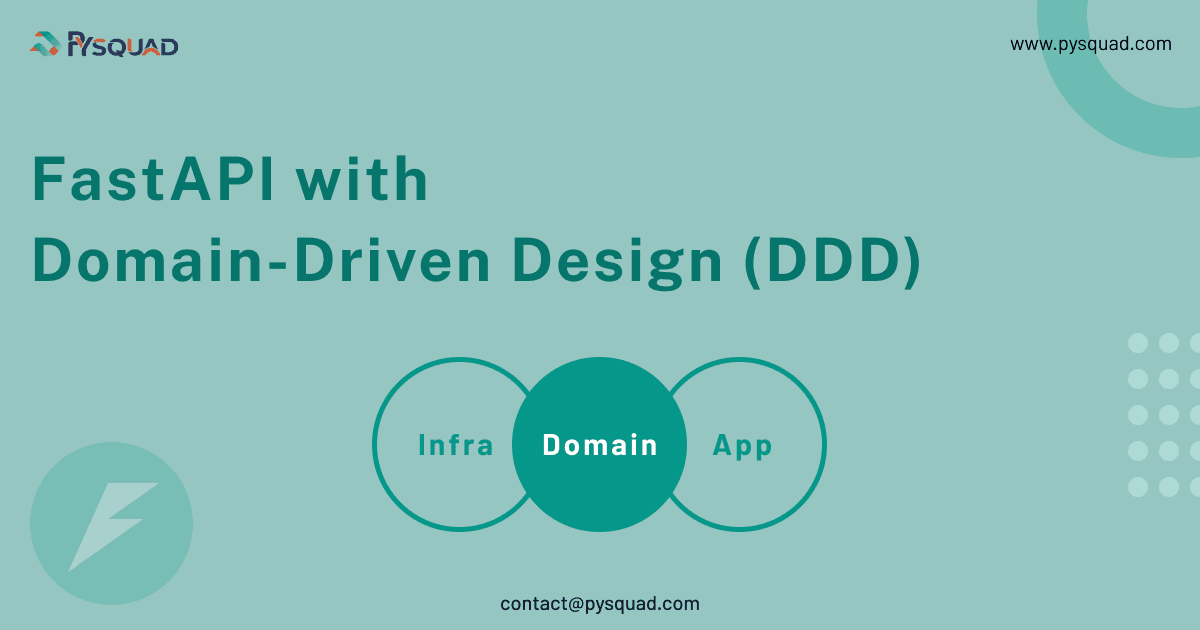
FastAPI Application Architecture with Domain-Driven Design
FastAPI makes it easy to build APIs quickly. Domain-Driven Design (DDD) makes it possible to build systems that survive growth, change, and complexity.
When teams combine FastAPI with DDD, they often expect instant clarity. What they usually get instead is confusion:
- Where should business logic live?
- What belongs in services vs routers?
- How much DDD is too much?
- Is this overkill for a startup?
Why Architecture Becomes a Problem in FastAPI Projects
FastAPI encourages speed. Routers, dependencies, and schemas are easy to compose. Early on, this feels great.
Then the system grows:
- More endpoints
- More rules
- More edge cases
- More people touching the code
Suddenly:
- Business logic is scattered
- Changes break unrelated features
- Tests become hard to write
- Onboarding slows down
The problem is not FastAPI. The problem is missing structure around business complexity.
This is exactly where Domain-Driven Design helps.
What Domain-Driven Design Really Means (In Practice)
DDD is often misunderstood as a heavy, academic approach. In reality, its core ideas are simple.
At its heart, DDD says:
- The business domain matters more than frameworks
- Code should reflect how the business thinks
- Complex logic deserves clear boundaries
In FastAPI terms, this means:
- Routers handle HTTP, not business rules
- Domains own behavior, not controllers
- Infrastructure details stay at the edges
DDD is not about adding layers. It is about putting logic where it belongs.
A Practical Mental Model for FastAPI + DDD
Instead of starting with folders, start with questions:
- What are the core business capabilities?
- What rules must always be true?
- What changes often vs rarely?
From there, structure emerges naturally.
A useful way to think about it:
FastAPI = delivery mechanism
DDD = business logic organization
They solve different problems and complement each other well.
Core Building Blocks in a DDD-Oriented FastAPI App
You do not need every DDD concept. Start with the ones that bring clarity.
1. Domains
A domain represents a core business area.
Examples:
- Orders
- Payments
- Users
- Inventory
Each domain should:
- Own its business rules
- Be understandable in isolation
- Avoid depending on FastAPI specifics
Think of domains as mini applications inside your system.
2. Entities and Value Objects
Entities have identity and lifecycle.
Examples:
- User
- Order
- Subscription
Value Objects represent concepts without identity.
Examples:
- Money
- Address
Why this matters:
- Rules live close to the data they protect
- Invalid states become harder to create
This reduces defensive checks scattered across endpoints.
3. Domain Services
Some logic does not belong to a single entity.
Examples:
- Pricing calculations
- Eligibility checks
- Risk evaluation
Domain services:
- Express business rules
- Remain framework-agnostic
- Are easy to test
They are not "service layers" in the traditional CRUD sense.
4. Application Layer
The application layer coordinates work.
Responsibilities:
- Orchestrate domain objects
- Handle use cases
- Manage transactions
In FastAPI projects, this is often where teams go wrong by skipping it entirely.
Without an application layer:
- Routers become bloated
- Business logic leaks into HTTP handlers
5. Infrastructure Layer
This is where technical details live:
- Databases
- ORMs
- External APIs
- Message brokers
Key rule:
The domain should not know how data is stored or fetched.
FastAPI dependencies, database sessions, and external clients belong here.
A Simple Coding Example (FastAPI + DDD, Pragmatic)
Below is a minimal, realistic example to make the architecture concrete. This is not a full framework, just enough structure to show intent.
Example Use Case: Create an Order
We will separate concerns clearly:
- Domain owns rules
- Application coordinates
- FastAPI delivers HTTP
1. Domain Layer
Domain Entity (order.py)
from dataclasses import dataclass
from typing import List

@dataclass
class OrderItem:
    product_id: str
    quantity: int
    price: float

    def total(self) -> float:
        return self.quantity * self.price


@dataclass
class Order:
    id: str
    items: List[OrderItem]

    def total_amount(self) -> float:
        if not self.items:
            raise ValueError("Order must contain at least one item")
        return sum(item.total() for item in self.items)
Notice:
- No FastAPI
- No ORM
- Business rules live close to the data
2. Domain Service
Domain Service (pricing.py)
from .order import Order

class PricingService:
    def calculate_total(self, order: Order) -> float:
        total = order.total_amount()
        if total > 1000:
            return total * 0.95  # simple bulk discount
        return total
This logic does not belong to HTTP or persistence.
3. Application Layer
Use Case (create_order.py)
from uuid import uuid4
from domain.order import Order, OrderItem
from domain.pricing import PricingService
from infrastructure.repositories import OrderRepository

class CreateOrderUseCase:
    def __init__(self, repo: OrderRepository, pricing: PricingService):
        self.repo = repo
        self.pricing = pricing

    def execute(self, items_data: list[dict]) -> dict:
        items = [OrderItem(**item) for item in items_data]
        order = Order(id=str(uuid4()), items=items)

        total = self.pricing.calculate_total(order)
        self.repo.save(order)

        return {
            "order_id": order.id,
            "total": total,
        }
The application layer:
- Coordinates work
- Calls domain logic
- Does not know about HTTP
4. Infrastructure Layer
Repository Interface + Implementation
class OrderRepository:
    def save(self, order):
        raise NotImplementedError


class InMemoryOrderRepository(OrderRepository):
    def __init__(self):
        self._orders = []

    def save(self, order):
        self._orders.append(order)
Later, this can be replaced with a database-backed repository without touching domain logic.
5. FastAPI Layer (Thin by Design)
from fastapi import APIRouter, Depends
from application.create_order import CreateOrderUseCase
from domain.pricing import PricingService
from infrastructure.repositories import InMemoryOrderRepository

router = APIRouter()


def get_use_case():
    return CreateOrderUseCase(
        repo=InMemoryOrderRepository(),
        pricing=PricingService(),
    )


@router.post("/orders")
def create_order(payload: dict, use_case: CreateOrderUseCase = Depends(get_use_case)):
    return use_case.execute(payload["items"])
The router:
- Translates HTTP to a use case call
- Contains no business rules
Why This Structure Scales
- Business logic is testable without FastAPI
- HTTP changes do not affect domain rules
- Infrastructure can evolve independently
- Complexity stays localized
This is DDD used lightly and intentionally, not ceremonially.
How FastAPI Fits Into This Structure
FastAPI works best when it stays thin.
In a DDD-oriented setup:
- Routers translate HTTP to application calls
- Dependencies provide infrastructure wiring
- Pydantic schemas handle I/O, not domain models
This separation gives you:
- Cleaner endpoints
- Testable business logic
- Freedom to change infrastructure later
FastAPI becomes a boundary, not the core.
Common Mistakes When Mixing FastAPI and DDD
Over-Engineering Too Early
If your app is a simple CRUD tool with no real business rules, full DDD may slow you down.
Start small. Let complexity justify structure.
Treating DDD as Folder Structure
DDD is about behavior and boundaries, not directories.
A perfect folder layout with poor separation is still a mess.
Letting ORMs Define the Domain
Database models are not domain models.
When persistence concerns leak into business logic:
- Rules become harder to reason about
- Changes become risky
When DDD Pays Off the Most in FastAPI Projects
DDD shines when:
- Business rules are complex
- Multiple teams work on the same codebase
- The product is expected to evolve for years
- Bugs are costly
If you recognize these signs, investing in structure early saves time later.
Where PySquad Can Help
Adopting DDD is not about copying patterns. It is about making thoughtful trade-offs.
At PySquad, we help teams:
- Introduce DDD incrementally without slowing delivery
- Refactor existing FastAPI apps safely
- Identify which parts actually need domain modeling
- Design architectures that scale with both product and team
We focus on clarity over ceremony.
The goal is not a perfect diagram. The goal is a system your team can reason about six months from now.
Final Thoughts
FastAPI gives you speed. Domain-Driven Design gives you resilience.
Used together thoughtfully, they help teams move fast without losing control.
If your FastAPI codebase is starting to feel fragile or hard to change, that feeling is a signal. Architecture is not about predicting the future. It is about being ready for it.
Written with real-world FastAPI systems and evolving product teams in mind, by the PySquad engineering team.