Results depend on scope, integrations and adoption.
The operating context
A clearer view of the whole operation.
Every supply chain generates data across procurement systems, ERPs, warehouse platforms, transportation systems, inventory tools, and supplier networks. Most organizations have more data than ever before, yet planners and operations teams still struggle to answer simple questions about delays, inventory risk, transportation costs, and supplier performance. The challenge is not collecting data. The challenge is turning fragmented information into operational decisions before problems impact customers and margins.
Where friction builds
You Have Supply Chain Data Everywhere. Visibility Nowhere.
Most companies rely on ERP reports, spreadsheets, BI dashboards, and disconnected supply chain software tools to manage daily operations. While these systems provide historical visibility, they rarely help teams identify risks before they impact inventory, transportation, suppliers, or customer service. Analysts spend valuable time collecting and reconciling data from multiple platforms instead of investigating root causes, improving planning accuracy, or optimizing supply chain performance.
The problem becomes even greater as supply chains grow more complex. Traditional reporting tools focus mainly on descriptive analytics, showing what happened, and sometimes diagnostic analytics, explaining why it happened. Modern supply chains require all 4 types of analytics: descriptive, diagnostic, predictive, and prescriptive. Without a unified supply chain analytics software solution, organizations struggle to forecast disruptions, optimize operations, reduce inefficiencies, and make proactive decisions that protect margins and service levels.
Current approach
Separate reports for procurement, inventory, and logistics
Static dashboards with delayed data
Manual consolidation of metrics across teams
Limited ability to analyze disruptions or scenarios
Operational impact
No end-to-end supply chain visibility
Late response to risks and disruptions
Poor alignment between planning and execution
High effort to maintain and update reports
Inside the solution
The capabilities behind the operation.
Review the functional scope, then discuss the requirements specific to your team.
End-to-end supply chain visibility
Unified view across suppliers, warehouses, production, and transport operations.
Demand, inventory, and capacity insights
Highlights shortages, excess stock, bottlenecks, and capacity constraints.
Supplier and partner performance analytics
Tracks delivery reliability, quality issues, and dependency risks.
Disruption and risk monitoring
Early signals and impact analysis for potential supply chain disruptions.
Scenario and what-if analysis
Evaluates planning alternatives and supports resilience planning.
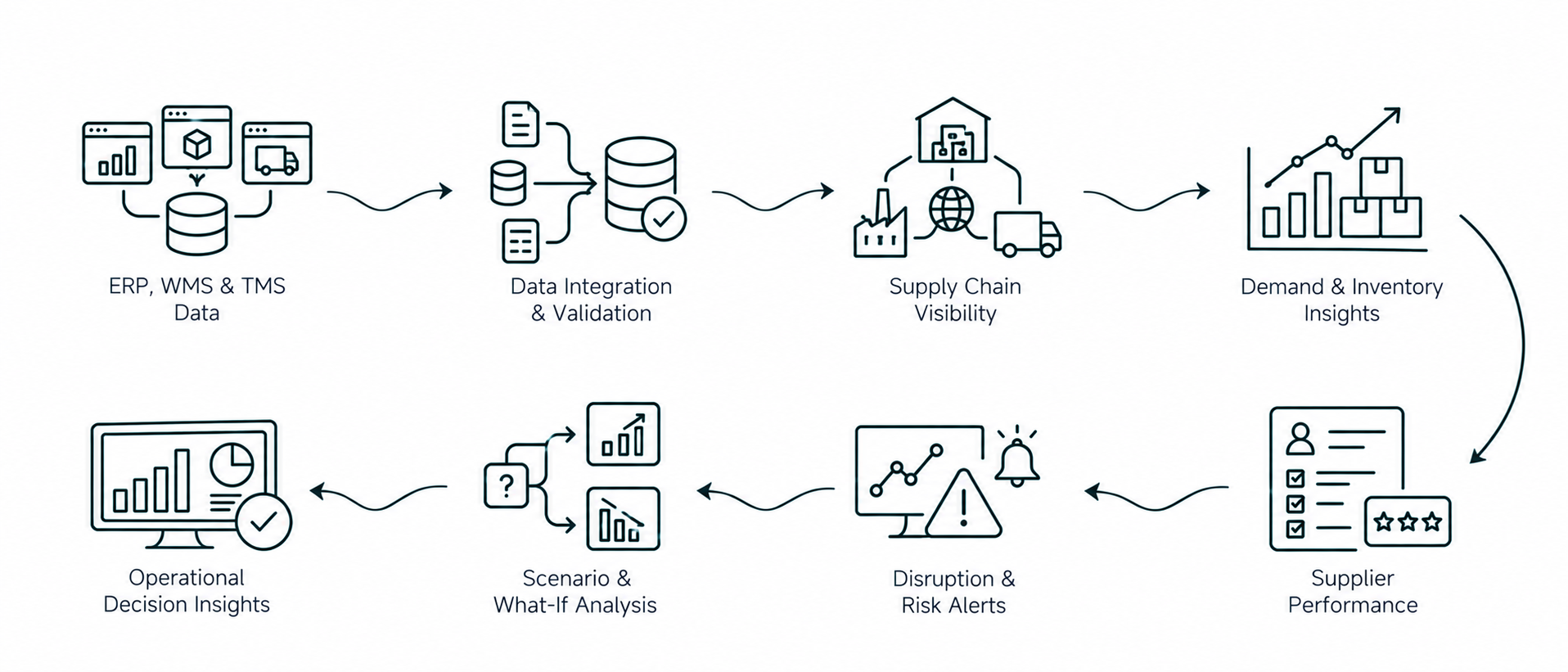
PySquad develops custom supply chain analytics software solutions that connect ERP, WMS, TMS, inventory, and logistics data into a unified analytics environment. By combining real-time visibility, predictive analytics, and operational intelligence, we help supply chain teams reduce reporting delays, identify inefficiencies faster, and make proactive decisions across planning, inventory, and transportation operations.
How it connects
The complete workflow, in one view.
Make an informed decision
Is this the right fit?
The right solution starts with the right operating requirements.
Supply chain analysts commonly use ERP systems, WMS platforms, TMS solutions, Power BI, Tableau, and specialized supply chain analytics software. The most effective organizations connect these systems into a unified analytics platform for complete visibility.
Can supply chain analytics software integrate with ERP, WMS, and TMS systems?
Yes. Modern supply chain analytics software is designed to connect with ERP, warehouse management, transportation management, procurement, and logistics systems. This creates a unified source of truth across the supply chain.
How does supply chain analytics software improve supply chain planning?
Supply chain analytics software helps planners forecast demand, optimize inventory levels, evaluate capacity constraints, and identify potential disruptions. This improves planning accuracy while reducing stockouts, excess inventory, and operational risk.
Which ERP is best for supply chain management?
Popular ERP solutions for supply chain management include SAP, Oracle, Microsoft Dynamics, and Infor. The best choice depends on business requirements, industry complexity, integration needs, and long-term scalability goals.
What are supply chain planning systems and why are they important?
Supply chain planning systems help organizations manage demand forecasting, inventory optimization, production planning, and capacity management. They provide the foundation for proactive and data-driven supply chain decisions.
Start with your requirements
Let’s define your next step.
Tell us what needs to work better, the systems you use, and the scope you have in mind.