Reduced input waste through accurate inventory and field tracking
Better crop planning supported by real time operational visibility
Improved yield forecasting and production analysis
Stronger cost control across labor, equipment, and farming activities
Results depend on scope, integrations and adoption.
The operating context
A clearer view of the whole operation.
Odoo Agriculture Management System helps agricultural businesses manage rising input costs, labor shortages, and increasing pressure to improve farm productivity. Commercial farming operations need accurate visibility into crops, field activities, inventory, and yields across multiple locations. Manual records and disconnected tools make operational planning difficult and reduce profitability.
Where friction builds
Poor crop visibility leads to costly farm decisions
Many farms still manage crop schedules, labor assignments, inventory usage, and field activities through paper records, spreadsheets, or separate software tools. Managers often lack real time visibility into fertilizer consumption, irrigation schedules, equipment utilization, and crop progress. As operations grow, maintaining consistency becomes increasingly difficult.
Without a connected system linking planning, field execution, inventory, and harvest results, farms struggle to control costs and improve productivity. Input waste increases, yield forecasts become unreliable, and management teams make important decisions using incomplete or outdated information.
Current approach
Track crop activities through spreadsheets and handwritten farm records
Manage inventory, labor, and field operations in separate systems
Record irrigation and input usage after activities are completed
Review farm performance only after harvest season ends
Operational impact
Input costs rise because field usage is poorly tracked
Managers identify problems only after crop performance declines
Labor productivity is difficult to compare across locations
Yield forecasts remain unreliable without complete operational data
Inside the solution
The capabilities behind the operation.
Review the functional scope, then discuss the requirements specific to your team.
Farm, Field and Crop Planning
Manage farms, fields, plots, crop cycles, varieties, planting dates, seasonal plans, expected yields, and growing stages from one system.
Field Operations and Treatments
Plan and record planting, irrigation, fertilization, spraying, crop treatments, scouting, harvesting, and other field activities by crop and location.
Farm Inventory and Purchasing
Track seeds, fertilizers, pesticides, chemicals, and other farm inputs while connecting field consumption with stock levels, purchasing, and replenishment.
Labor, Machinery and Equipment
Track labor hours, worker assignments, machinery usage, equipment activity, and operating costs against farms, fields, crops, and seasonal work.
Harvest and Yield Management
Record harvest quantities, batches, quality, actual yield, inventory movement, and performance against crop and seasonal production targets.
Farm Costing and Profitability
Combine input, labor, machinery, purchasing, harvest, sales, and accounting data to analyze production cost, yield performance, and profitability by crop, field, or season.
Product walkthrough
See the solution in action.
Take a closer look before starting a conversation.
Document crop cycles, field operations, and seasonal planning requirements
02
Configure Odoo around farm specific workflows and reporting needs
03
Digitize field activity reporting through mobile accessible processes
04
Connect inventory usage directly to crops, fields, and growing stages
05
Track labor, equipment, and operational costs at field level
06
Build yield and profitability dashboards for management teams
Our approach
PySquad starts by mapping seasonal planning, field operations, labor workflows, inventory usage, irrigation activities, and harvest processes. We configure Odoo around actual agricultural operations, connect field level data collection, establish crop and inventory tracking structures, and build reporting systems that provide managers with accurate visibility into productivity, costs, and yield performance across every growing cycle.
How it connects
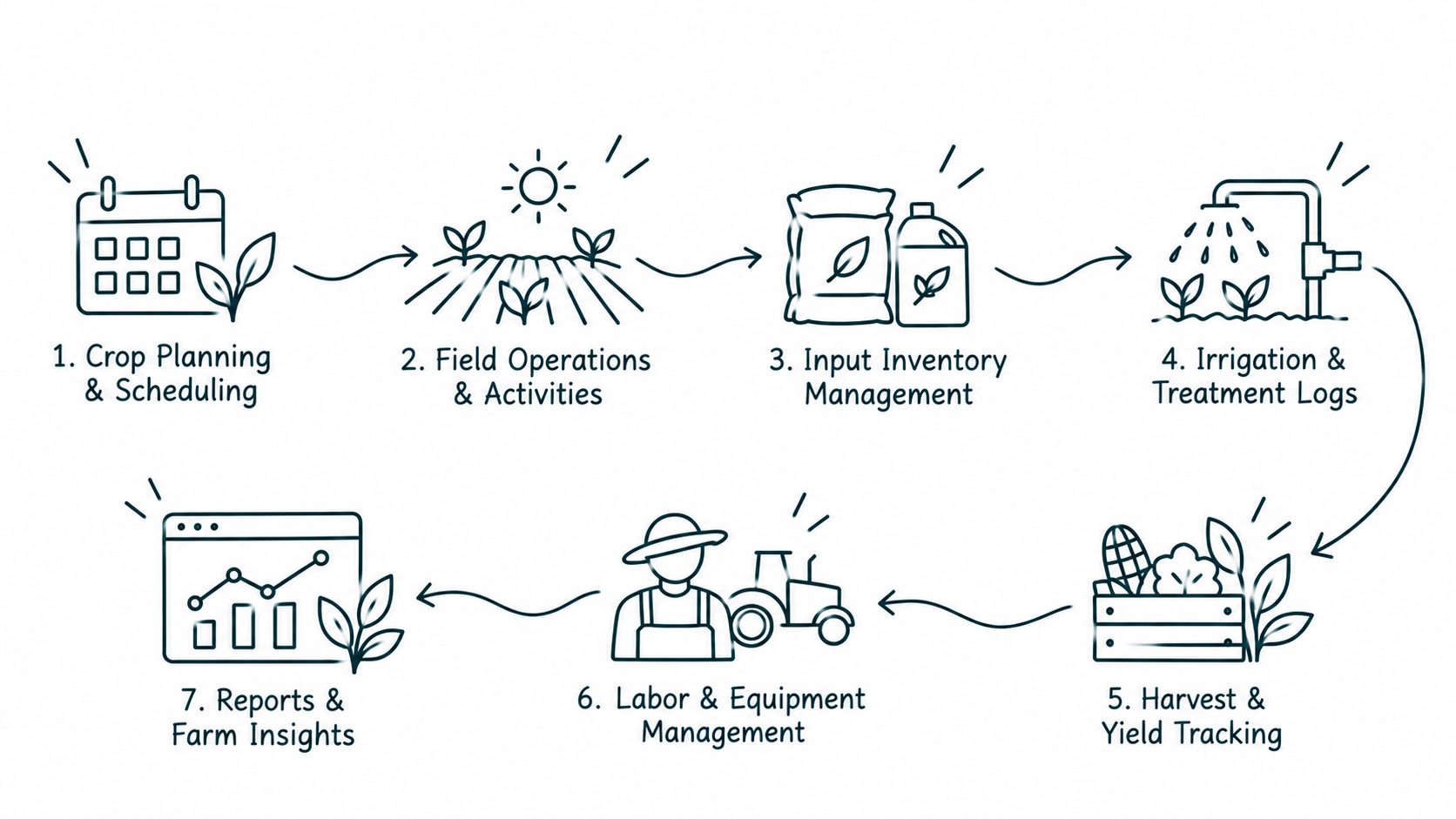
The complete workflow, in one view.
Make an informed decision
Is this the right fit?
The right solution starts with the right operating requirements.
An Odoo Agriculture Management System is a farm management software platform that centralizes crop planning, field operations, inventory tracking, labor management, and harvest monitoring. It helps agricultural businesses replace spreadsheets and manual records with structured workflows that improve visibility, productivity, and operational decision making.
Can Odoo manage multiple farms and growing locations?
Yes. The system supports multiple farms, fields, greenhouses, and agricultural sites within a single platform. Managers can track activities, inventory, crop performance, and operational costs across locations while maintaining centralized reporting and control through an agriculture ERP software environment.
How does the system track fertilizer and chemical usage?
The platform records fertilizer, pesticide, seed, and chemical consumption by field, crop, and activity. This allows farm managers to understand input costs, monitor usage patterns, and reduce waste. Accurate farm inventory management also improves purchasing decisions and seasonal planning.
Can farm workers update field activities from mobile devices?
Yes. Supervisors and field teams can record planting, irrigation, spraying, harvesting, and maintenance activities through mobile friendly workflows. This improves data accuracy and gives managers near real time visibility into daily operations without waiting for manual reporting at the end of the day.
Does Odoo Agriculture Management System support yield forecasting?
Yes. The platform combines crop plans, historical production records, field activities, and operational data to support yield tracking software and forecasting processes. Managers can compare expected and actual results, identify performance trends, and make better planning decisions for future growing seasons.
Start with your requirements
Let’s define your next step.
Tell us what needs to work better, the systems you use, and the scope you have in mind.