Reduced time required to launch branded chatbot deployments
Higher answer consistency across support and internal use cases
Centralized management of multiple client chatbot environments
Improved visibility into chatbot adoption and performance metrics
Results depend on scope, integrations and adoption.
The operating context
A clearer view of the whole operation.
White-label AI chatbot solutions are becoming a practical way for agencies and enterprises to deliver AI capabilities without building and maintaining chatbot infrastructure from scratch. As demand grows for AI-powered support, sales, and internal assistants, teams need systems that can be managed, branded, secured, and deployed across multiple environments.
Where friction builds
Why most enterprise AI chatbot projects fail after launch
Many teams invest in enterprise AI chatbot projects expecting quick wins, only to face inaccurate responses, disconnected data sources, permission issues, and rising maintenance costs once real users arrive.
Most deployments rely on generic models and prompt-only logic. Without controlled retrieval, governance, and monitoring, chatbot performance declines as usage grows.
Current approach
Connect a chatbot directly to a public AI model
Depend on prompt engineering alone for accuracy
Deploy separate chatbot instances for every client
Launch chatbots without performance monitoring
Operational impact
Unreliable or incorrect responses
Security and data exposure risks
Operational costs increase with every new deployment
Problems remain hidden until users report failures
Inside the solution
The capabilities behind the operation.
Review the functional scope, then discuss the requirements specific to your team.
Workflow driven chatbot design
Every chatbot is structured around defined support, sales, or operational processes.
Complete white label branding
Apply custom branding, interface elements, domains, and conversational tone.
Controlled knowledge retrieval
Connect approved data sources with safeguards that improve answer quality.
Role based access controls
Manage permissions and data visibility across users, teams, and clients.
Business system integrations
Connect CRM, ERP, support platforms, and internal tools to chatbot workflows.
Usage monitoring and analytics
Track conversations, adoption trends, and performance metrics over time.
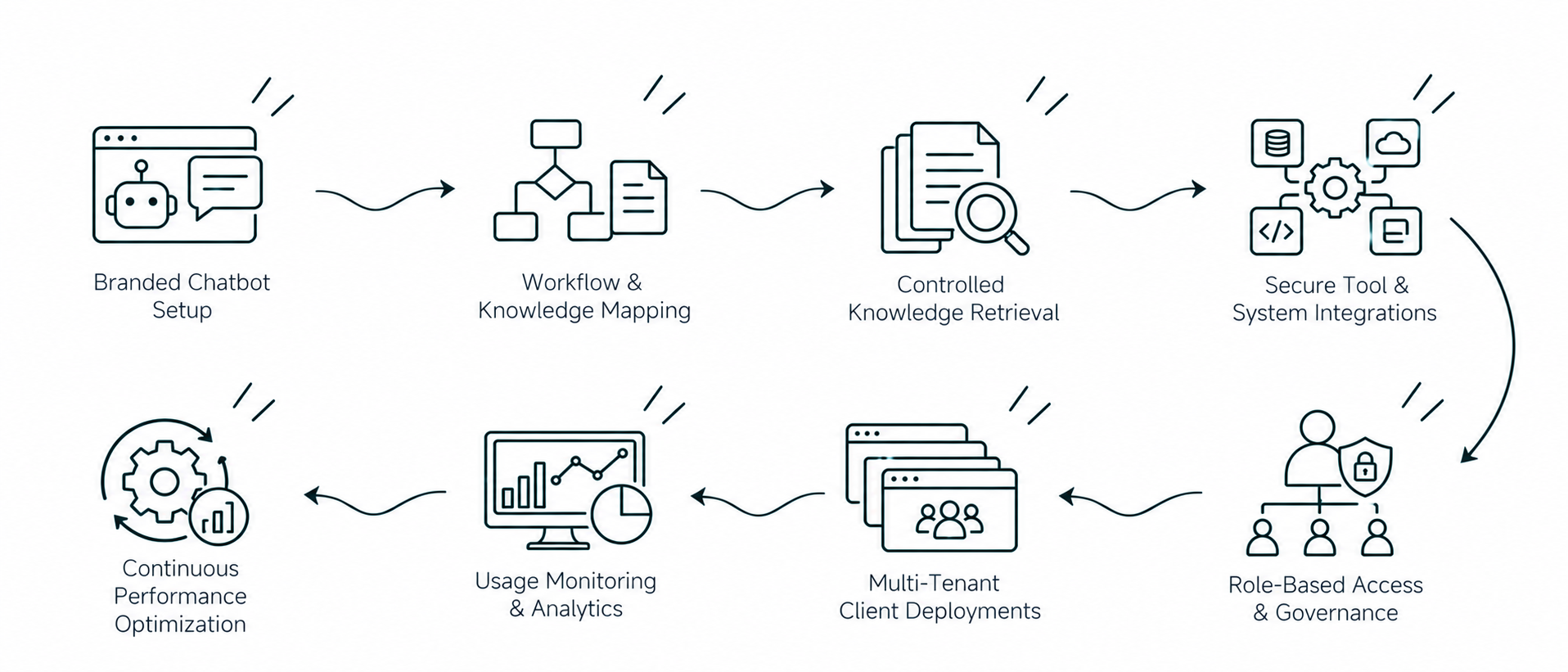
Map business workflows before defining chatbot behavior
02
Audit data sources and user access requirements early
03
Design retrieval logic around approved knowledge repositories
04
Build multi tenant architecture for repeatable deployments
05
Integrate operational systems directly into chatbot workflows
06
Monitor usage patterns and refine performance continuously
Our approach
At PySquad, we treat every chatbot as an operational system rather than a standalone AI feature. We begin by mapping business workflows, user permissions, and knowledge sources before selecting the right architecture. From there, we build controlled retrieval layers, secure integrations, multi-tenant deployment structures, and monitoring processes that allow agencies and enterprises to manage chatbot performance, compliance, and client-specific requirements over time.
How it connects
The complete workflow, in one view.
Make an informed decision
Is this the right fit?
The right solution starts with the right operating requirements.
White-label AI chatbot solutions allow agencies, SaaS companies, and enterprises to deploy branded AI assistants under their own identity. Instead of building chatbot infrastructure from scratch, teams use a customizable platform with their own branding, workflows, integrations, and knowledge base while maintaining control over the user experience.
Can a white-label AI chatbot be customized for each client?
Yes. Each chatbot deployment can have separate branding, knowledge sources, permissions, workflows, and integrations. This is especially useful for agencies managing multiple clients because it allows consistent operations while giving every client a tailored AI assistant experience.
How do you improve AI chatbot accuracy in production?
Accuracy comes from controlled knowledge retrieval, approved data sources, monitoring, testing, and fallback logic. Rather than relying only on prompts, we structure retrieval systems and business rules that help the AI assistant provide more reliable responses across real business scenarios.
Can white-label AI chatbots integrate with existing business systems?
Yes. Most deployments connect with CRM platforms, support tools, ERP systems, internal databases, and other operational software. These integrations allow the chatbot to access relevant information and support workflow automation while maintaining security and permission controls.
Do white-label AI chatbot solutions support long-term growth?
Yes. Multi-tenant architecture, monitoring, analytics, and modular integrations make it easier to expand chatbot deployments over time. Organizations can add new clients, departments, knowledge bases, and AI assistant capabilities without rebuilding the entire platform.
Start with your requirements
Let’s define your next step.
Tell us what needs to work better, the systems you use, and the scope you have in mind.