Results depend on scope, integrations and adoption.
The operating context
A clearer view of the whole operation.
Marketplaces power many of today’s most successful digital businesses by connecting buyers, sellers, service providers, or partners on a single platform. But building and running a marketplace requires more than listings and payments. It demands vendor coordination, transaction reliability, revenue logic, and scalability from day one. White-label marketplace software allows businesses to own the platform, data, and revenue while avoiding the risk and complexity of building everything from scratch.
Where friction builds
Marketplaces do not struggle because of demand. They struggle because the platform cannot scale with complexity.
Many marketplace teams underestimate the operational complexity behind multi-vendor systems. Managing vendors, commissions, orders, payouts, disputes, and growth often leads to high development costs, delayed launches, and fragile platforms.
Third-party marketplace tools limit control over data and revenue models, while custom builds often take too long to reach production. Without a strong foundation, marketplaces fail when users, vendors, and transactions start to scale.
Current approach
Using third-party marketplace SaaS tools
Building marketplaces with generic ecommerce platforms
Hardcoding vendor logic without scalability
Treating payments and payouts as afterthoughts
Operational impact
Limited control over platform data and revenue
Difficulty scaling vendors and transactions
Complex and error-prone payout workflows
Costly rewrites as the platform grows
Inside the solution
The capabilities behind the operation.
Review the functional scope, then discuss the requirements specific to your team.
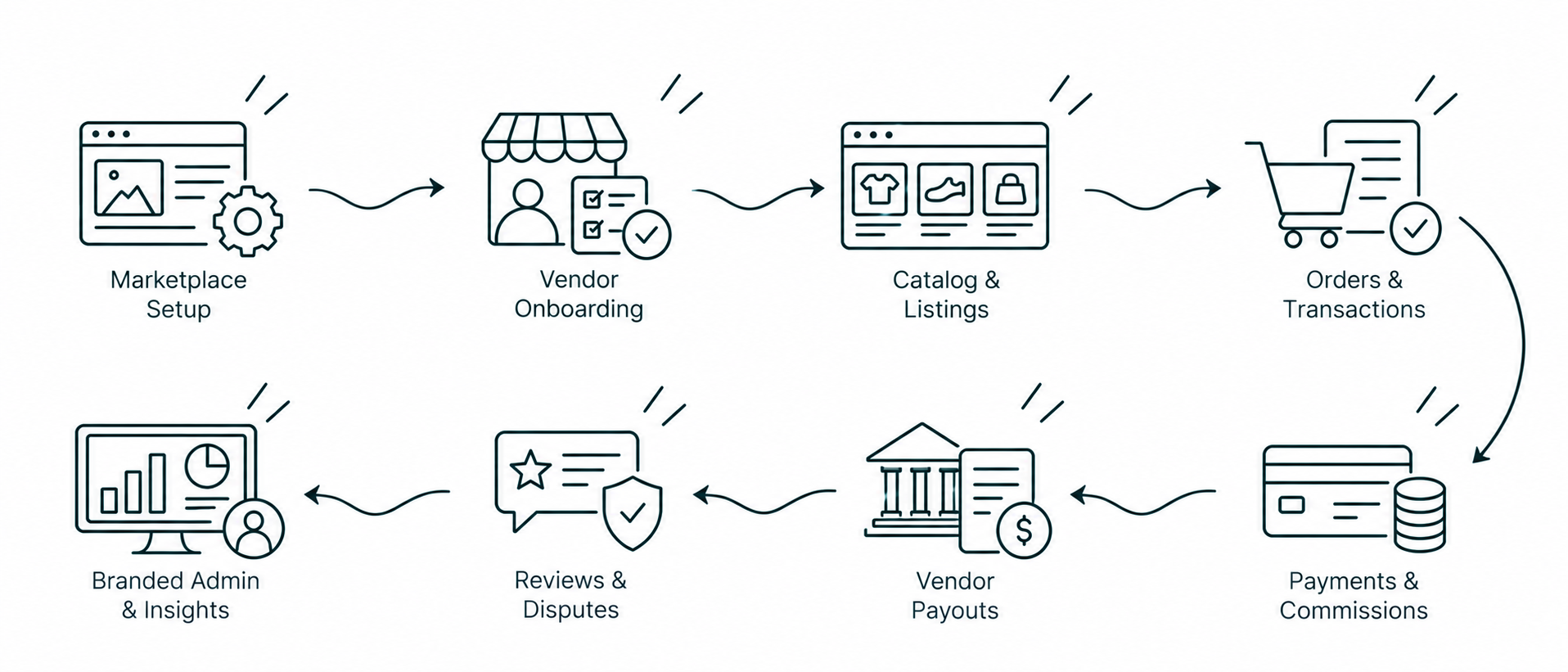
Vendor Management
Vendor onboarding, approvals, dashboards, and controlled access.
Product or Service Catalog
Vendor-managed listings with categories, pricing, and availability.
Orders and Transactions
Multi-vendor cart, order tracking, and status management.
Payments and Commissions
Flexible commission models with automated vendor payouts.
Ratings and Disputes
Reviews, issue handling, and trust-building workflows.
White-Label Admin Control
Custom branding, role-based access, analytics, and reporting.
Design marketplace logic around your business model
02
Separate vendor, buyer, and admin responsibilities clearly
03
Build payment and commission flows early
04
Architect for scale and long-term ownership
Our approach
We build white-label marketplace platforms as real products, not demos. Our focus is on clean business logic, vendor independence, secure transactions, and scalable architecture. Every marketplace is designed around how vendors operate, how money flows, and how the platform grows over time.
How it connects
The complete workflow, in one view.
Make an informed decision
Is this the right fit?
The right solution starts with the right operating requirements.
Do we own the marketplace platform and source code?
Yes. Full ownership and IP rights are transferred to you.
Can this support different marketplace models?
Yes. Product-based, service-based, or hybrid models are supported.
Can vendors manage their own products and orders?
Yes. Vendors get dedicated dashboards with controlled access.
Is this suitable for enterprise-scale marketplaces?
Yes. The architecture is designed for high volume and growth.
Can the marketplace support different commission and payout rules?
Yes. The marketplace can be configured with vendor-specific commissions, percentage-based fees, and different settlement schedules. Payment processing and automated payouts depend on the selected payment provider, supported marketplace payment capabilities, and the business's operating requirements.
Start with your requirements
Let’s define your next step.
Tell us what needs to work better, the systems you use, and the scope you have in mind.