

Skip to solutionCurrent approach Operational impact How it connects 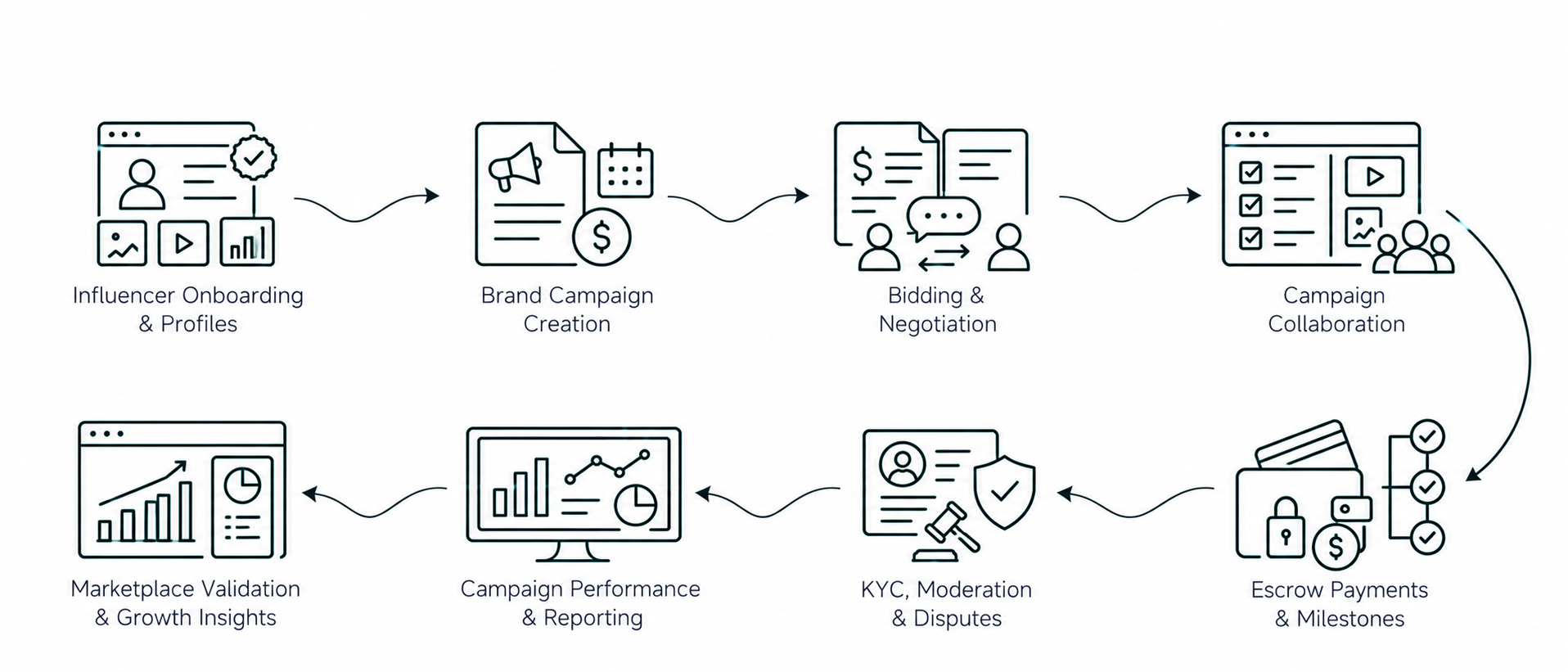























Big world.
Influencer Marketplace Platform (Django + React)
Build an influencer marketplace MVP with Django backend and React frontend, user profiles, campaign management, secure payments, and analytics for fast market validation.
Built around your operation
- Influencer marketplace startups
- Creator economy platforms
- Marketing technology companies
The business case
Higher trust through secure payments and structured workflows
Lower development and iteration cost during MVP stage
A scalable foundation for advanced features like discovery and analytics
Results depend on scope, integrations and adoption.
The operating context
A clearer view of the whole operation.
Influencer marketplaces operate across multiple layers, including creators, brands, payments, and performance tracking. Early success depends on how well these elements are connected and how much trust the platform creates for both sides. If onboarding is unclear, payments feel risky, or campaign outcomes are not visible, users drop off quickly. A well-structured MVP brings these workflows together into a single system, allowing founders to test demand while maintaining operational clarity and user confidence.
Where friction builds
Influencer marketplaces fail when MVPs skip trust and operations
Many teams rush to launch influencer platforms with a focus on UI and discovery but overlook the operational backbone. Matching between brands and influencers is often handled manually, payments are managed outside the platform, and campaign tracking is inconsistent. This creates friction for both sides and increases the operational burden on founders. Without clear workflows for onboarding, campaign execution, payments, and reporting, the platform struggles to deliver value. As a result, trust remains low, user engagement drops, and iteration becomes expensive due to weak system foundations.
- Coordinate brand and influencer workflows manually
- Handle payments outside the platform
- Provide limited campaign performance visibility
- Build tightly coupled MVP architecture
- Low trust between brands and creators
- High operational workload for founders
- Weak marketplace demand validation
- Costly rework when scaling features
Inside the solution
The capabilities behind the operation.
Review the functional scope, then discuss the requirements specific to your team.
Influencer Onboarding and Profiles
Create detailed profiles with audience metrics, portfolios, verification flags, and media uploads.
Brand Onboarding and Campaign Creation
Build campaigns with budgets, briefs, invitations, and structured proposal workflows.
Bidding and Negotiation
Enable in-platform proposals, bid management, and messaging between brands and influencers.
Escrow Payments and Milestones
Support secure deposits, milestone-based releases, refunds, and dispute handling.
Admin Moderation and Controls
Manage KYC verification, content moderation, platform fees, and dispute resolution.
Basic Analytics and Reporting
Provide campaign performance metrics with dashboards and exportable reports.
From requirements to implementation
Grounded in the way your team works.
How we work- 01
Define the minimum workflows required to validate marketplace value early
- 02
Build a Django backend with clear separation of marketplace domains
- 03
Deliver a React frontend focused on usability and fast interactions
- 04
Design systems so payments, analytics, and discovery can scale later
Our approach
We build influencer marketplace MVPs around real collaboration workflows between brands and creators. Using Django for backend structure and React for frontend usability, we design systems that handle onboarding, campaign management, payments, and visibility in a connected flow. Our focus is on getting the core marketplace interactions right so that early users can trust the platform and founders can gather meaningful insights. The architecture is designed to support iteration without requiring major rework
The complete workflow, in one view.
Make an informed decision
Is this the right fit?
The right solution starts with the right operating requirements.
Check the fit with usDesigned for
- Influencer marketplace startups
- Creator economy platforms
- Marketing technology companies
- Influencer-focused digital agencies
May not be suitable for
- One-off campaign tools
- UI-only prototype projects
- Platforms without payment flows
- Non-scaling marketplace projects
A closer look
Trusted by clients worldwide
See it on your workflows
Discuss your requirementsWalk through the solution with your operation in mind.
Before you decide
Questions worth asking.
Ask something elseHow long does an MVP take to build?
Typical timeline is 6–10 weeks depending on final scope and integrations.
Which payment gateways do you support?
We integrate common gateways (Stripe, PayPal, Razorpay) and can build escrow flows using their APIs.
Will the MVP be scalable to add features like recommendations?
Yes, the architecture is API-first and modular to support recommendation engines and advanced analytics.
Can influencers upload media and proof of work?
Yes, media uploads with secure storage, processing, and verification flags are included.
Do you handle compliance and KYC for brands/influencers?
Yes, the admin panel supports KYC workflows, document uploads, and verification processes.
Start with your requirements
Let’s define your next step.
Tell us what needs to work better, the systems you use, and the scope you have in mind.
Discuss your requirementsShare your requirements through our enquiry form.A little closer, wherever you are
Big world.
Close partnership.
Good work travels. We bring product engineering, AI and Odoo ERP to the conversation, and make room for your way of working.
01 / BaseAhmedabadIndia, remote
02 / ApproachOne shared planDiscovery to delivery
03 / ConnectionBuilt around youAgreed meeting rhythm