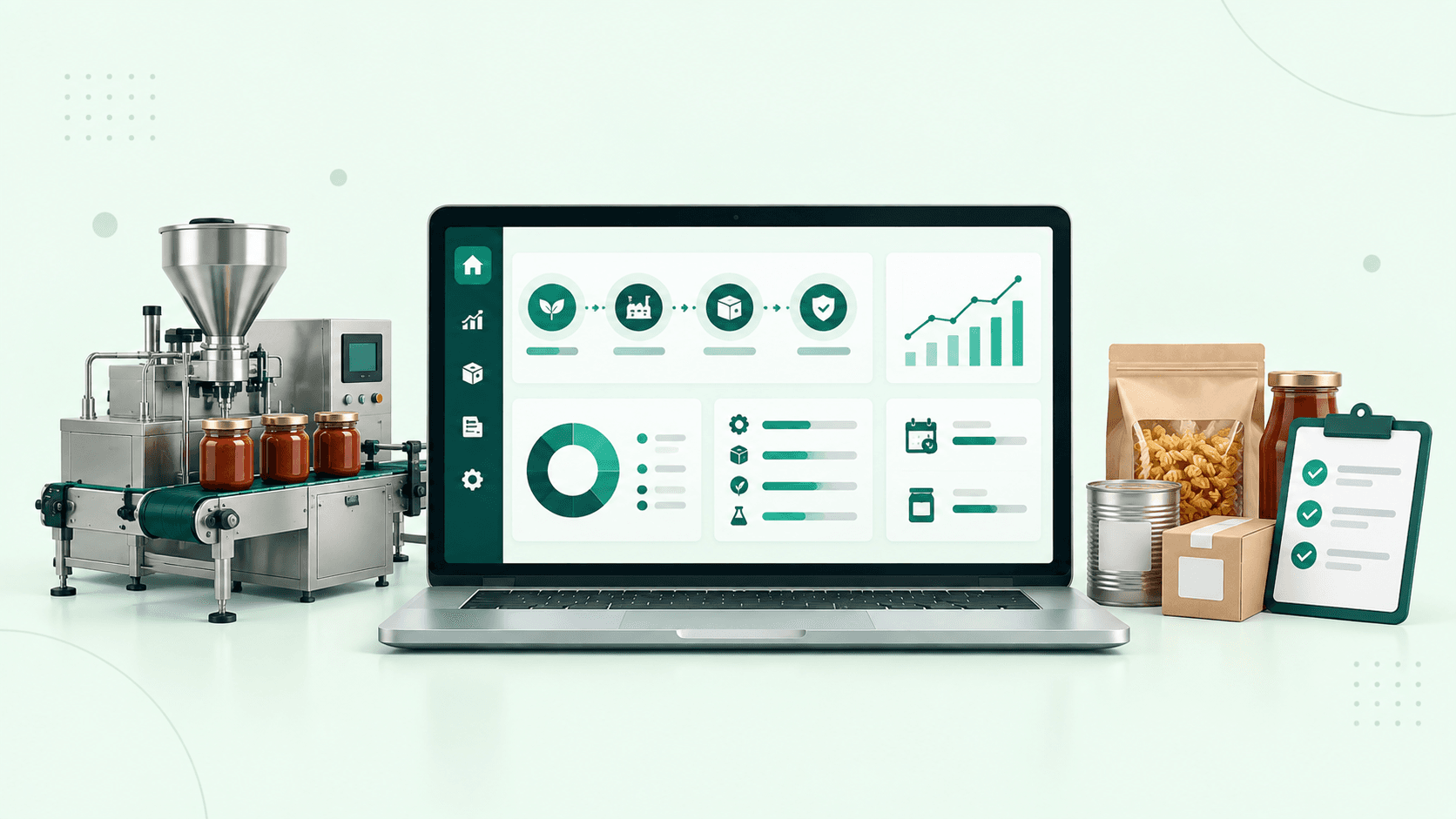
Odoo ERP for Food Manufacturing Operations

ERP configured for food safety, traceability, and plant-level execution. Built to run daily operations, not just accounting.

Preview for Odoo ERP for Food Manufacturing Operations

Trusted by clients worldwide

Marinapy
Vanilla Steel
INT Express
InnovationM
Telco Holdings International
Inglasco International
Upex Electrical UK
Lux Logic Lighting
CM3 Engineering
Finest Travel Africa
CareNav
XA Global Trade Advisors
Predictores.ai
iTech Consulting
Net Informatica
TextureAI UK
Lux Via
EEN Consulting
Intelgrity Ltd
OTEK Consulting
AI-O AI

Context

Food manufacturing operations are tightly regulated and operationally complex. Production planning, batch traceability, quality checks, shelf life, and compliance must work together in real time. Generic ERP setups often ignore food safety realities, forcing teams back to spreadsheets and paper logs. This solution focuses on configuring Odoo ERP specifically for food manufacturing workflows so operations, quality, and finance operate on the same trusted system.

Who this is for

We work best with teams who treat software as an operating system for the business, not a one-off project.

Good fit

  • Food manufacturers with batch or lot-based production
  • Plants operating under food safety and traceability regulations
  • Mid-sized manufacturers scaling products or facilities
  • Operations teams replacing spreadsheet-driven control

Not a fit

  • Businesses seeking accounting-only ERP setups
  • Very small units with minimal compliance needs
  • Teams unwilling to follow system-driven processes
  • Companies looking for generic ERP templates

The operating reality

Why ERP implementations fail in food manufacturing

Most ERP systems are implemented with a finance-first mindset. Food safety, traceability, quality checks, and shelf-life controls are added later or handled outside the system. This leads to partial adoption, manual workarounds, audit stress, and unreliable operational data.

How this is usually solved (and why it breaks)

Common approaches

  • Implement Odoo with standard manufacturing settings
  • Handle food safety outside the ERP
  • Rely on manual batch and expiry tracking
  • Focus on go-live instead of operational adoption

Where it falls short

  • Weak traceability during audits or recalls
  • Mismatch between production and inventory data
  • Manual quality and compliance effort
  • Low ERP usage by plant teams

Does this match your constraints?

Talk to us before you commit to another generic build.

Schedule a discussion

Core capabilities we implement

Building blocks that keep delivery predictable under real operating load.

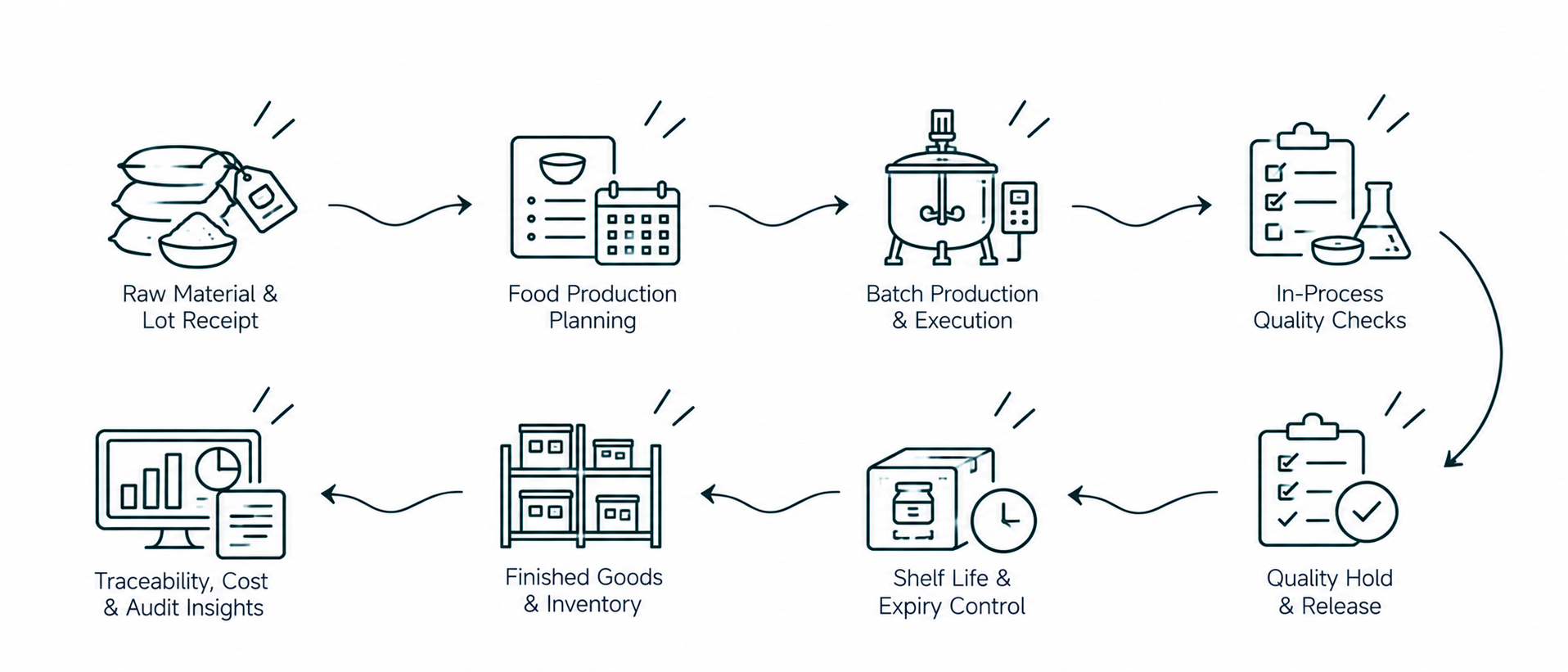
Batch and Lot Traceability

Track raw materials, work-in-progress, and finished goods across batches and lots.

Production Planning and Execution

Food-specific BOMs, routings, and production workflows aligned to plant operations.

Quality and Food Safety Workflows

In-process checks, holds, and approvals embedded into production and inventory.

Shelf Life and Expiry Management

Automated expiry tracking with controls on usage and dispatch.

Inventory and Cost Visibility

Accurate stock, wastage, and costing visibility across food operations.

How we approach delivery

  1. Step 1

    Map real food plant workflows before configuration

  2. Step 2

    Design traceability and safety as core ERP flows

  3. Step 3

    Configure for operator usability, not just reporting

  4. Step 4

    Stabilize data accuracy before advanced automation

Engineering standards at PySquad

We design Odoo around food manufacturing realities. Production, quality, inventory, and compliance workflows are modeled first, then connected cleanly to finance and reporting.

Expected outcomes

What teams plan for when scope, integrations, and release are handled as one program.

  • Reliable traceability for audits and recalls

  • Improved production and inventory accuracy

  • Reduced manual food safety effort

  • Higher ERP adoption across plant teams

Frequently asked questions

Straight answers procurement and engineering teams ask before a build kicks off.

Yes. We configure Odoo to enforce batch, lot, and expiry controls across production, inventory, and dispatch, not as optional fields.

Absolutely. Quality checks, approvals, and traceability are built into daily workflows, making audits far less stressful.

Yes. The setup supports multiple products, variants, and plants with standardized yet flexible workflows.

We prioritize configuration over heavy customization. Extensions are added only where food-specific logic truly requires it.

Most teams see better visibility and control within weeks once production and inventory workflows go live.

About PySquad

What is PySquad?

A software engineering team for complex operations. We build tools that fit how you work, not software that forces you to change everything overnight.

What do you get on a project like this?

Discovery, build, integrations, testing, release, and follow-up once real users are in the product. You talk to engineers and leads who own the outcome.

Looking for similar Odoo Implementation?

Share scope, constraints, and timelines. We respond with a clear delivery approach, not a generic pitch deck.

Start the conversation

Where we deliver

This solution is delivered by PySquad squads across the US, UK, UAE, Europe, India, and more. Open a region page for local delivery context.

Ready to build? Let's talk.

Tell us what you are building, which systems matter, and the outcome you need. We reply within 24 hours with a clear next step.

50+ teams · Production-ready delivery · Reply within 24h

Prefer a structured brief?