Vertical SaaS Platform for Food Manufacturing Industry

Purpose-built software for food manufacturing realities. Designed for safety, traceability, and scale.

Preview for Vertical SaaS Platform for Food Manufacturing Industry

Context

Food manufacturers often rely on generic ERP or horizontal SaaS tools that do not fully understand food safety, batch traceability, shelf life, or audit pressure. As operations scale, these gaps turn into manual workarounds, compliance risk, and slow innovation. This solution focuses on building a vertical SaaS platform designed specifically for food manufacturing workflows, regulations, and operational constraints.

Who this is for

We usually work best with teams who know building software is more than just shipping code.

This is for teams who

Food manufacturers building industry-specific digital platforms

Founders productizing internal food manufacturing workflows

Enterprises modernizing legacy food software

Companies launching SaaS products for food operations

This may not fit for

Businesses seeking generic ERP or CRM tools

Teams looking for one-off custom applications

Companies without clarity on their food manufacturing niche

Founders not ready for long-term product ownership

Problem framing

The operating reality

Why generic software fails food manufacturers

Horizontal SaaS tools force food manufacturers to adapt their processes to the software. Critical needs like batch traceability, quality holds, recall readiness, and plant-level execution are bolted on later. This leads to fragmented systems, high customization costs, and limited scalability.

How this is usually solved (and why it breaks)

Common approaches

Build horizontal SaaS and customize for food later

Hard-code customer-specific logic

Treat compliance as a separate module

Scale users before stabilizing core workflows

Where these approaches fall short

High maintenance and customization cost

Weak food safety and traceability support

Slow customer onboarding

Platform instability at scale

Delivery scope

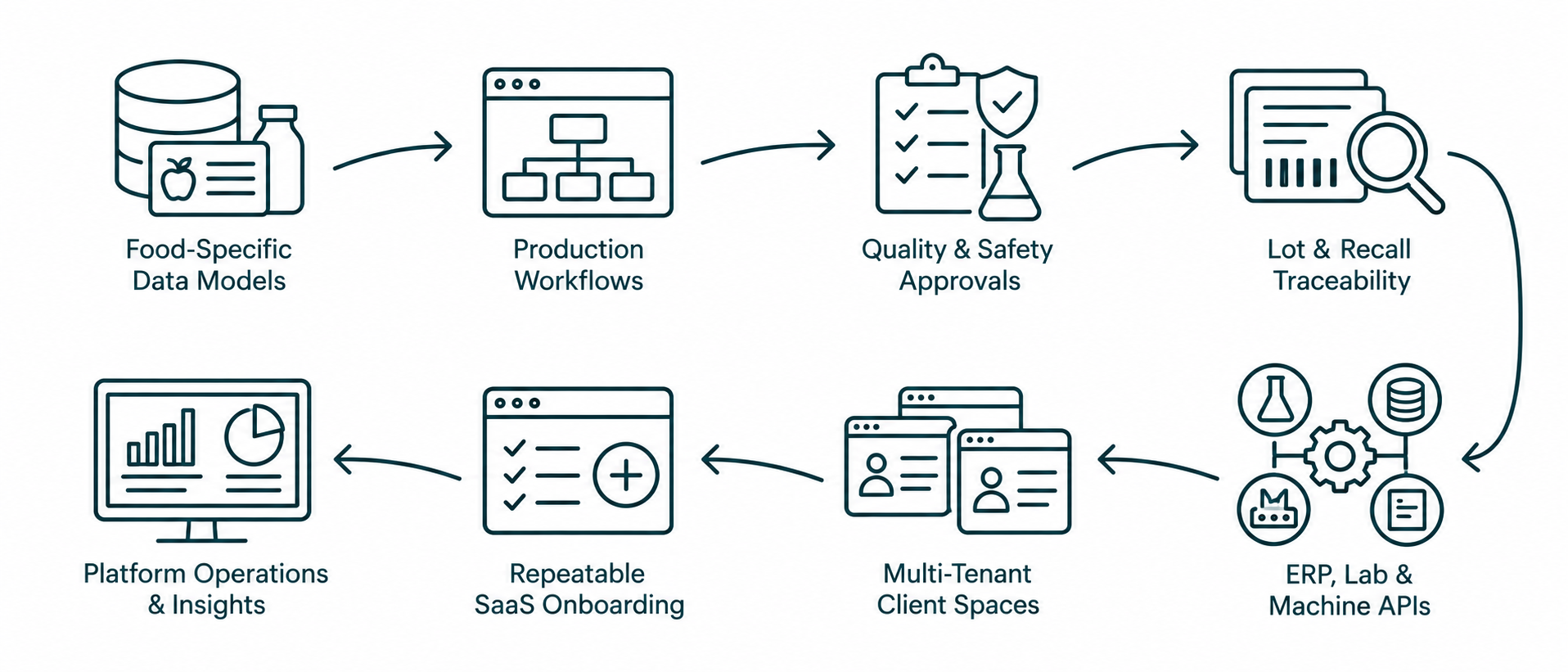
Core capabilities we implement

Structured building blocks we use to de-risk delivery and keep enterprise programs predictable.

01

Food-Specific Data Models

Core entities designed around batches, lots, shelf life, and food safety attributes.

02

Workflow-Driven Operations

Purpose-built workflows for production, quality checks, and approvals.

03

Compliance-Ready Architecture

Audit trails, traceability, and safety controls embedded into the platform.

04

Multi-Tenant SaaS Foundation

Secure tenant isolation, role-based access, and scalable infrastructure.

05

Integration-First Design

APIs to integrate with ERP, machines, labs, and third-party systems.

How we approach delivery

01

Start with a focused food manufacturing use case

02

Design safety and traceability into the core

03

Build repeatable onboarding and workflows

04

Scale only after operational stability

Engineering standards at PySquad

We build vertical SaaS products from the ground up around food manufacturing workflows. Data models, permissions, and automation are designed with food safety and execution in mind, not added as afterthoughts.

Expected outcomes

Measurable results teams plan for when we ship the full stack, integrations, and governance together.

01

A SaaS platform aligned with food manufacturing needs

02

Faster customer onboarding with less customization

03

Lower compliance and operational risk

04

Strong foundation for long-term product growth

Build a SaaS platform made for food manufacturing.

Share scope, constraints, and timelines. We respond with a clear delivery approach, not a generic pitch deck.

Start the conversation

Frequently asked questions

Straight answers procurement and engineering teams ask before a build kicks off.

It is designed around food-specific workflows like batch traceability, quality checks, shelf life, and compliance, not adapted from generic software.

Yes. The platform is built with integration-first architecture to work alongside ERPs, MES, and other plant systems.

Compliance is modeled as configurable workflows and controls, allowing regional and customer-specific requirements without breaking the core platform.

Both. Startups can launch focused MVPs, while established companies can modernize or productize existing systems incrementally.

A focused, production-ready MVP can typically be launched within a few months, depending on scope and complexity.

About PySquad

Short answers if you are deciding who builds and supports this kind of work.

What is PySquad?
We are a software engineering team. PySquad works with people who run complex operations and need tools that fit how they work, not software that forces them to change everything overnight.
What do you get from us on a project like this?
Discovery, build, integrations, testing, release, and follow up when real users are in the product. You talk to engineers and leads who own the outcome, not a rotating cast of handoffs.
Who do we work with most often?
Teams in logistics, marketplaces, marina, aviation, fintech, healthcare, manufacturing, and other fields where downtime hurts and clarity matters. If that sounds like your world, we are easy to talk to.

have an idea? lets talk

Share your details with us, and our team will get in touch within 24 hours to discuss your project and guide you through the next steps

happy clients50+
Projects Delivered20+
Client Satisfaction98%