
In this article
For years, enterprise automation meant doing boring things faster. NIVA is quietly turning it into something that actually feels intelligent.
Think about the last time you dealt with a big company. Maybe you were chasing an invoice, or trying to update your account, or just asking a simple question that somehow needed three departments to answer. You probably got bounced around. A form here, a hold queue there, a chatbot that clearly had no idea what you were talking about.
Now here is the strange part. That company almost certainly had automation in place. Lots of it. And yet the experience still felt clumsy, slow, and weirdly impersonal.
That is the dirty secret of enterprise automation. For most of its life, it has been very good at speed and very bad at understanding. It can process a thousand requests an hour, but it cannot tell the difference between a frustrated customer, a curious one, and one who is ready to spend money right now.
NIVA is changing that, and the idea behind it is surprisingly human.
Enterprise automation has a personality problem
Most automation tools are built around a single identity. One voice, one set of skills, one way of handling everyone who shows up.
On paper that sounds efficient. In the real world it is the reason so much automation feels cold.
A large business is not one conversation. It is hundreds of different conversations happening at the same time, with people who want completely different things. A returning client with a complaint needs patience and a quick resolution. A new lead needs confidence and clear answers. An employee buried in paperwork needs speed and zero fuss.
When you force all of that through one generic system, everybody gets the same flat experience. It is a bit like hiring one person to be your receptionist, your accountant, your sales lead, and your support team, all at once, and then wondering why none of those jobs gets done particularly well.
So what is a multi-persona AI agent
Here is the simplest way to picture it.
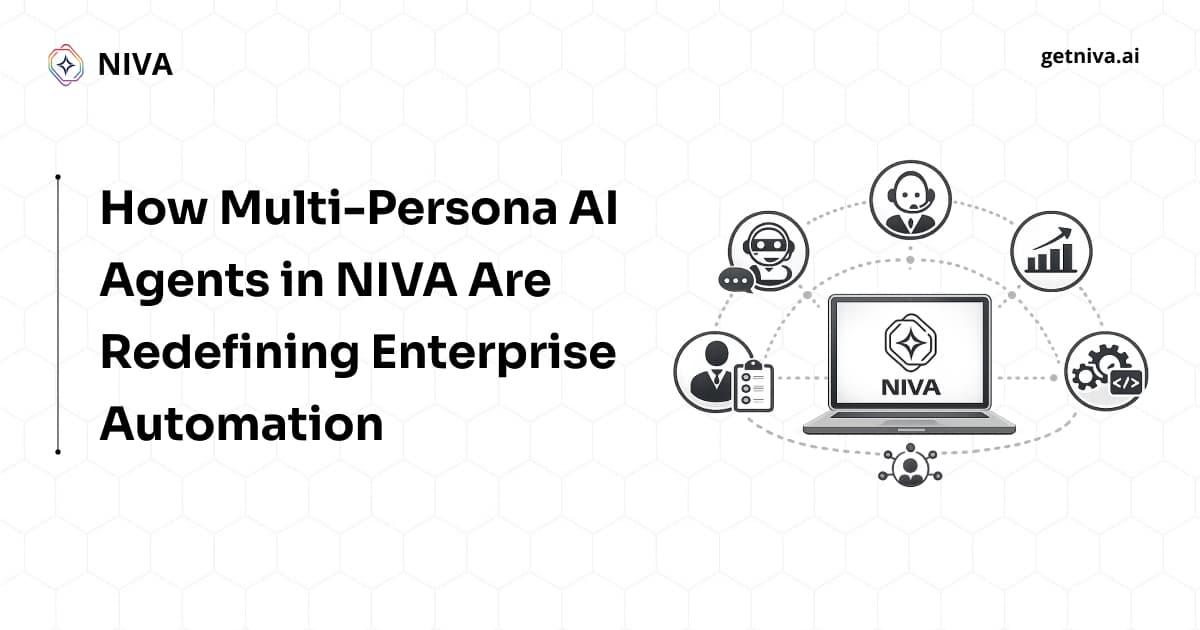
Imagine a single assistant who can instantly become whoever the moment requires. The friendly greeter when someone first arrives. The sharp sales advisor when the conversation turns to pricing. The calm problem solver when something has gone wrong. The patient guide when a customer is lost.
Not four different tools. One presence that shifts its role, its tone, and its focus based on who it is talking to and what they actually need.
That is what a multi-persona AI agent does. Inside NIVA, a single system can carry the knowledge and the manner of many specialists, and move between them without missing a beat. The customer never sees the switch. They just feel understood, which is the part that has been missing from automation all along.
Why one AI brain was never enough for a whole business
A business is made of roles. Sales, support, onboarding, operations, finance, and a dozen others. Each of those roles has its own way of speaking, its own priorities, and its own idea of what a good outcome looks like.
A salesperson and a support agent can be looking at the exact same customer and want two completely different things to happen next. That is not a flaw. That is how a healthy organization works.
Old automation flattened all of that into one tone and one script. It treated variety as a problem to be standardized away. NIVA treats variety as the whole point. Instead of pretending every interaction is the same, it gives the business an automation layer that can wear many hats and know exactly when to wear each one.
The result is automation that finally matches the shape of a real company, rather than forcing the company to shrink down to fit the tool.
What changes when your automation can switch roles
This is where it stops being a nice idea and starts being a real advantage. When your automation can change persona on the fly, the everyday experience shifts in ways people notice immediately.
- Sales conversations feel like guidance, not pressure. When someone shows buying intent, the agent leans into a confident, helpful sales role and moves the conversation forward instead of reciting a brochure.
- Support feels calmer and faster. A frustrated customer gets a steady, solution-first persona that focuses on fixing the issue, not defending the company.
- Onboarding stops being a maze. New users get a patient guide that walks them through the early steps, so they actually stick around instead of giving up on day one.
- Internal teams get time back. Employees stop drowning in repetitive requests because the agent handles the routine ones in the right tone, and only brings a human in when it truly matters.
- Every department sounds like itself. Finance feels precise, sales feels energetic, support feels warm, all from one system that knows how to read the room.
None of this requires the customer to learn anything new. They just talk, and the experience quietly bends to fit them.
The quiet shift from answering to acting
Here is the bigger story underneath all of this.
Older automation was built to answer. You asked, it replied, and that was the end of its job. Helpful in small doses, but it always left the actual work to you.
A multi-persona agent is built to act. It does not just respond to a request and stop. It understands the goal behind the request and moves things toward a finished result. Booking, updating, guiding, resolving, following up. The conversation leads somewhere instead of dead ending in a polite reply.
When you combine that ability to act with the ability to shift persona, you get something that feels less like a tool and more like a capable team member who happens to be available every hour of every day. That is a genuine leap, and it is the heart of why NIVA feels different from the automation most enterprises are used to.
What this means for the people who actually work there
There is a fear that hangs over every automation conversation, and it deserves an honest answer. People worry that smarter automation means fewer humans.
The reality on the ground tends to be the opposite of the scary version. When the routine, repetitive, soul-draining work gets handled well, the people are freed to do the work that actually needs a human. The tricky cases. The relationships. The judgment calls. The moments where empathy is not optional.
Most employees do not dream of answering the same five questions two hundred times a day. A multi-persona agent takes that weight off their shoulders and hands them back the interesting part of their job. The business moves faster, and the people get to do work that feels like it matters. That is a rare win where both sides come out ahead.
Where enterprise automation goes from here
We are watching the definition of automation change in real time.
For a long time, the goal was simply to remove human effort from a process. Faster, cheaper, hands off. That was the entire ambition. The experience on the other end did not really factor in.
The new goal is different. It is automation that understands context, adapts its approach, and carries a conversation the way a thoughtful person would. Not a script that runs the same way every time, but a presence that reads the situation and responds like it genuinely gets it.
Multi-persona AI agents are one of the clearest signs of that shift, and NIVA is putting the idea to work where it counts. The companies that lean into this early are going to feel like a step ahead, simply because their customers and their teams will notice the difference long before they can explain it.
The bottom line
Enterprise automation spent years being efficient and forgettable. It got the job done, but it rarely got it done well, and it almost never felt good.
Multi-persona AI agents flip that. By letting one intelligent system speak with many voices and pursue real outcomes, NIVA turns automation from a blunt instrument into something that feels attentive, capable, and genuinely useful.
The businesses still running one-size-fits-all automation are not wrong to use it. They are just about to find out what they have been missing. And once you have experienced automation that actually understands who it is talking to, the old way starts to feel like a very long time on hold.
Frequently asked questions
What is a multi-persona AI agent in simple terms? It is a single AI assistant that can take on different roles, like sales, support, or onboarding, and switch between them based on what each person needs in the moment.
How is this different from a normal chatbot? A normal chatbot uses one tone and one script for everyone. A multi-persona agent reads the situation and adapts, so the conversation feels relevant instead of generic.
Does this kind of automation replace employees? In practice it tends to remove the repetitive work and let people focus on the cases that truly need a human touch, which is usually the part of the job they enjoy most.
Why does NIVA focus on multiple personas instead of one smarter bot? Because real businesses are made of many roles, and a single voice cannot serve all of them well. Matching that variety is what makes the experience feel natural.