Building Digital Wallet MVPs With Django + React

Launch secure digital wallet MVPs with Django and React

Preview for Building Digital Wallet MVPs With Django + React

Trusted by clients worldwide

Marinapy
Vanilla Steel
INT Express
InnovationM
Telco Holdings International
Inglasco International
Upex Electrical UK
Lux Logic Lighting
CM3 Engineering
Finest Travel Africa
CareNav
XA Global Trade Advisors
Predictores.ai
iTech Consulting
Net Informatica
TextureAI UK
Lux Via
EEN Consulting
Intelgrity Ltd
OTEK Consulting
AI-O AI

Context

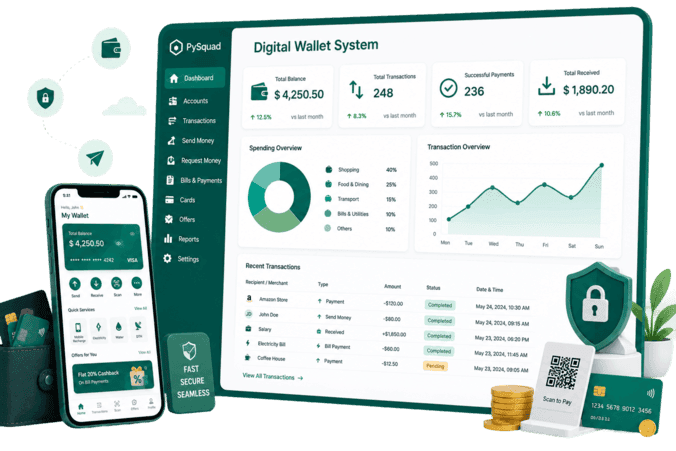
Digital wallets are becoming core infrastructure for fintech products and marketplaces. But building a wallet MVP means handling sensitive financial flows, verification, balances, and compliance, without slowing down iteration. We help founders launch secure, compliant digital wallet MVPs that are reliable from day one and designed to scale as transaction volume grows.

Who this is for

We work best with teams who treat software as an operating system for the business, not a one-off project.

Good fit

  • Building fintech products or marketplaces with wallets
  • Need secure balances, top-ups, and transfers
  • Require KYC, compliance, and audit-ready flows
  • Want smooth user-facing financial experiences
  • Need an MVP that can scale with transaction volume

Not a fit

  • Building non-transactional products
  • Don’t handle real money or stored balances
  • Want to bypass compliance or verification
  • Rely on manual reconciliation
  • Don’t plan to scale beyond early prototypes

The operating reality

A digital wallet MVP isn’t difficult because of screens or APIs. It’s difficult because money systems demand correctness from day one.

Founders must balance speed with security, handling real funds, preventing fraud, meeting compliance requirements, and keeping transactions accurate under failure scenarios. When these concerns are treated as add-ons, MVPs become fragile, audits become painful, and trust breaks quickly. A wallet MVP fails not when features are missing, but when financial integrity isn’t built into the foundation.

How this is usually solved (and why it breaks)

Common approaches

  • Relying on payment gateways for core wallet logic
  • Adding wallets as a layer on existing systems
  • Deferring compliance and audit trails
  • Manual reconciliation and dispute handling

Where it falls short

  • Limited control over transaction integrity
  • Difficult audits and regulatory exposure
  • High operational risk at scale
  • Costly rebuilds once volume increases

Does this match your constraints?

Talk to us before you commit to another generic build.

Explore FinTech Services

Core capabilities we implement

Building blocks that keep delivery predictable under real operating load.

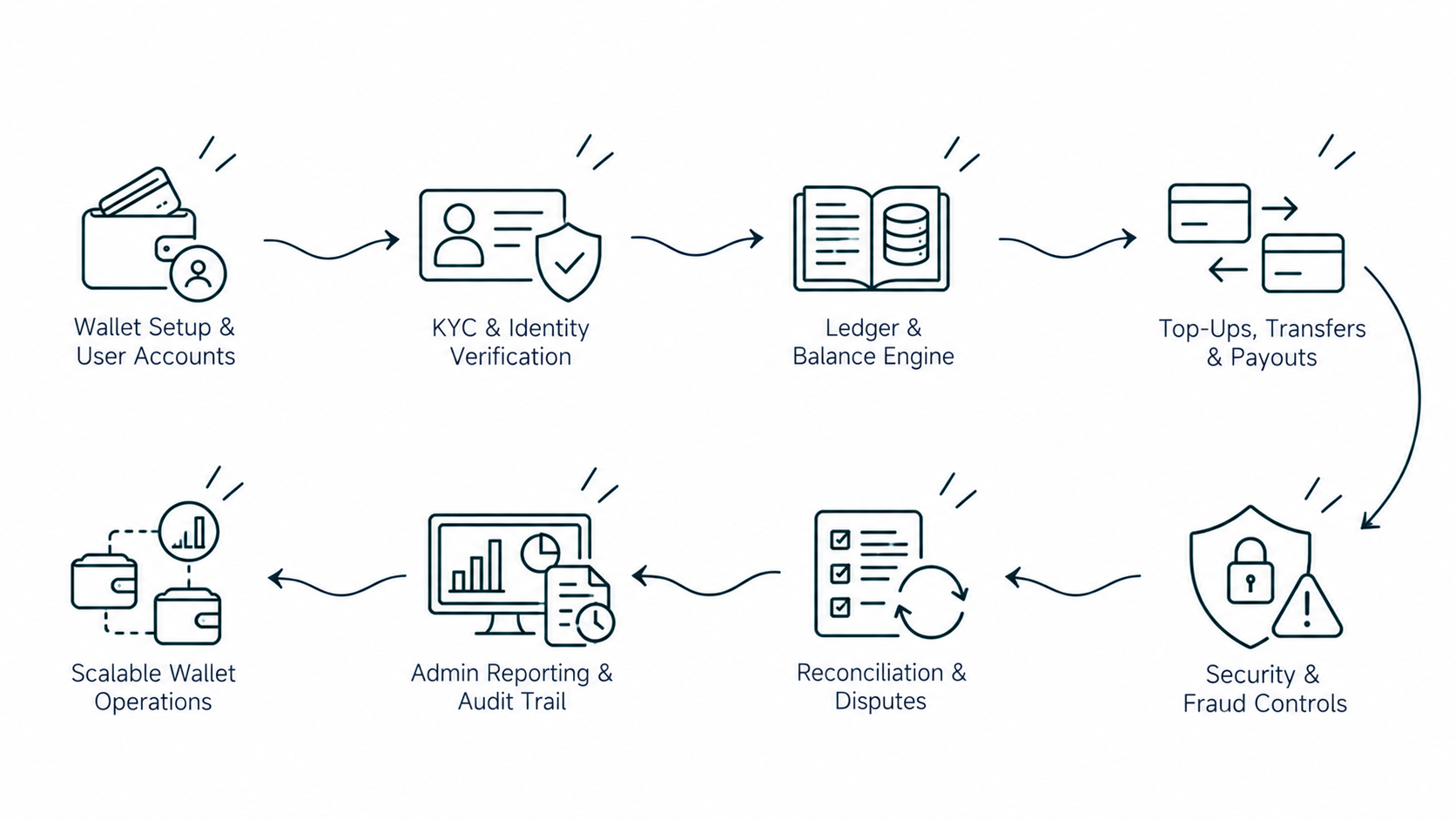
Wallet & Balance Management

Secure balance ledger with atomic transactions and full audit trails.

Transactions & Transfers

Top-ups, transfers, withdrawals, and payout workflows.

Compliance & Verification

KYC, AML, and identity verification flows.

Security & Risk Controls

Fraud detection, monitoring rules, and anomaly detection.

Admin & Reporting Tools

Disputes, adjustments, reconciliation, and reporting capabilities.

How we approach delivery

  1. Step 1

    Clarify financial flows early

  2. Step 2

    Separate ledger logic from presentation

  3. Step 3

    Build compliance-ready MVPs

  4. Step 4

    Design for scale and audits

Engineering standards at PySquad

Our digital wallet architecture is built for real money, real users, and real regulatory constraints. By focusing on transaction integrity, auditability, and secure integrations from the start, teams can launch faster without needing to rebuild once compliance, scale, and operational complexity inevitably catch up. The result is a wallet system that is production-ready from day one, resilient under real-world load, and trusted by both regulators and users.

Expected outcomes

What teams plan for when scope, integrations, and release are handled as one program.

  • Faster launch of wallet-based features

  • Reduced fraud and operational risk

  • Audit-ready transaction history

  • Scalable foundation for fintech growth

Frequently asked questions

Straight answers procurement and engineering teams ask before a build kicks off.

Yes. We integrate with KYC/AML providers and build verification workflows.

Through atomic ledgers, encryption, and strict access controls.

Stripe, Adyen, Razorpay, and direct bank APIs.

Yes. Multi-currency and FX handling can be implemented.

Typically 6–12 weeks depending on integrations and compliance needs.

About PySquad

What is PySquad?

A software engineering team for complex operations. We build tools that fit how you work, not software that forces you to change everything overnight.

What do you get on a project like this?

Discovery, build, integrations, testing, release, and follow-up once real users are in the product. You talk to engineers and leads who own the outcome.

Plan a similar initiative with our team

Share scope, constraints, and timelines. We respond with a clear delivery approach, not a generic pitch deck.

Start the conversation

Where we deliver

This solution is delivered by PySquad squads across the US, UK, UAE, Europe, India, and more. Open a region page for local delivery context.

Ready to build? Let's talk.

Tell us what you are building, which systems matter, and the outcome you need. We reply within 24 hours with a clear next step.

50+ teams · Production-ready delivery · Reply within 24h

Prefer a structured brief?