
In this article
Your chatbot should not just answer questions. It should get things done.
Think about the last time you interacted with a chatbot. Chances are, it answered your question, maybe pointed you somewhere useful, and then the conversation ended. Done. Helpful, sure. But was anything actually set in motion?
That is the gap most chatbot platforms refuse to address. They are built to respond, not to act. And for businesses that want automation to actually move work forward, that gap is the difference between a tool that saves you time and one that just shifts where the same work happens.
NIVA Flow Engine was built to close that gap.
What Workflow Automation Inside a Chatbot Even Means
Most people hear "workflow automation" and think of something that lives in a dashboard. A series of steps. Triggers. Conditions. Something you build in one tool and connect to another tool and hope holds together when the third tool updates its API.
That picture has not changed much in years. The tools got shinier. The integrations got longer. But the underlying idea stayed the same: automation lives somewhere separate, and your chatbot is just a front door.
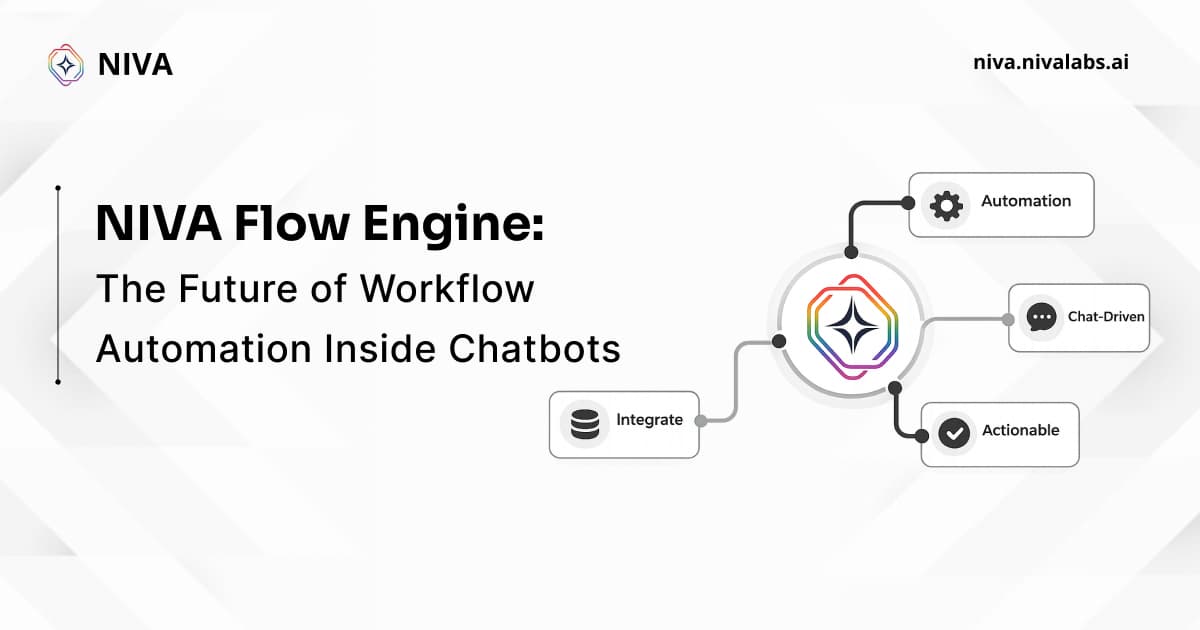
NIVA flips that model. With the Flow Engine, the chatbot is not the front door. It is the entire room.
A visitor starts a conversation. Based on what they say, where they are in their journey, what they have done before, the chatbot does not just reply. It triggers a sequence. It collects what it needs, passes it where it needs to go, updates records, notifies the right people, and keeps the conversation moving without dropping the thread. All inside a single interaction.
That is not a chatbot with automation bolted on. That is automation that happens to feel like a conversation.
The Old Way Was Held Together With Duct Tape
To be fair, the old way worked. It still works for a lot of teams. You build a chatbot over here. You build your CRM workflow over there. You add a Zapier step in the middle and pray nothing breaks during a product launch.
But here is what that setup actually costs you.
Every time a visitor completes a form inside your chatbot, someone has to make sure that data arrives cleanly on the other side. Every time your sales flow changes, you are updating logic in at least two places. Every time a new team member needs to understand how a process works, you are explaining a system that lives in four different tools and a folder of Loom videos.
And none of it is visible in one place. You cannot look at a single flow and see what happens from the moment someone says hello to the moment they become a customer or a closed support ticket.
NIVA Flow Engine changes what that picture looks like entirely.
Flows That Live Inside the Conversation
The reason this matters is not just convenience. It is accuracy.
When automation is disconnected from the conversation, information gets lost in translation. A chatbot collects a name, but the downstream system gets a field called "user_display_name." A customer says they are interested in a specific product, but by the time that signal reaches your sales team, it is a generic "inbound lead" with no context attached.
NIVA flows are built directly into the conversation layer. Every piece of context the chatbot gathers, every decision it makes, every signal it picks up from the person on the other end is immediately available to the flow. Nothing gets summarized, re-labeled, or dropped on the way.
That means the trigger is smarter. The conditions are richer. And the outcome on the other end actually reflects what the customer said, not just the fact that they said something.
What You Can Actually Build With It
Here is where things get interesting.
Picture a business that sells software to mid-size companies. They have an AI chatbot on their website. Before NIVA Flow Engine, the chatbot could answer questions about pricing, features, and integration options. Useful, but passive.
With the Flow Engine, the same conversation now does the following: it qualifies the lead in real time based on company size and intent signals, creates a contact record in the CRM with full conversation context attached, triggers a personalized follow-up email sequence, notifies the assigned account executive with a summary of exactly what was discussed, and schedules a callback if the visitor requested one. All without a human touching it. All before the visitor closes the tab.
That is one flow. A customer support team might run a different one: a user reports an issue, the flow checks their account status, routes technical problems to the engineering queue and billing questions to the finance team, logs the conversation, and sends a confirmation to the user with a case number and expected response time.
An e-commerce brand might use a flow to walk customers through a returns process step by step, confirm eligibility, initiate the return, update the order system, and send tracking information for the replacement, all within a single chat window.
None of these require code. None of them require three separate tools talking to each other across an integration layer that breaks when someone changes a field name.
Why This Is Different From What Already Exists
There are plenty of workflow builders out there. There are also plenty of chatbot platforms. The problem is that these two things almost never share a brain.
Workflow tools think in data and conditions. Chatbot platforms think in conversation and intent. Getting them to work together usually means one side has to simplify itself to fit the other. The conversation becomes rigid because the workflow demands clean inputs. Or the workflow stays shallow because the chatbot cannot pass enough context through.
NIVA was built as a single system from the start. The conversation layer and the flow layer share the same understanding of what is happening. The chatbot does not need to compress what it knows into a data packet and hand it off. The flow is already there, listening, acting as the conversation develops.
That design decision sounds small. The results are not.
Automation That Feels Like a Conversation Should
The best automation is the kind people do not notice. Not because it is hidden, but because it fits so naturally into what they were already doing that there is no friction to notice.
A customer who books a demo through your chatbot should not feel like they just filled out a form. They should feel like someone took care of everything while they were still talking. A support user who gets their issue routed correctly in real time should not feel like they got processed. They should feel like the system already knew what they needed.
That is the goal of NIVA Flow Engine. Not automation that impresses teams on a sales call, but automation that makes every person who starts a conversation feel like the experience was built specifically for them.
Because with enough context and the right flows in place, it was.
The Shift That Is Already Happening
Businesses are moving away from the idea that a chatbot is a support shortcut. The smarter ones are starting to see it as the central point where customer interaction and business processes meet.
That shift requires more than a smarter AI model. It requires a system that can act on what the AI learns. NIVA Flow Engine is built for exactly that moment, where the conversation stops being just a conversation and starts being the mechanism through which actual work gets done.
If your chatbot is still only answering questions, you are leaving most of the value on the table.
Ready to see what your chatbot looks like when it can actually take action? Explore NIVA Flow Engine and build your first workflow today.