All case studies
Insurance Tech

AI-Powered Patient Document Intelligence Platform for Automated TPA Submission

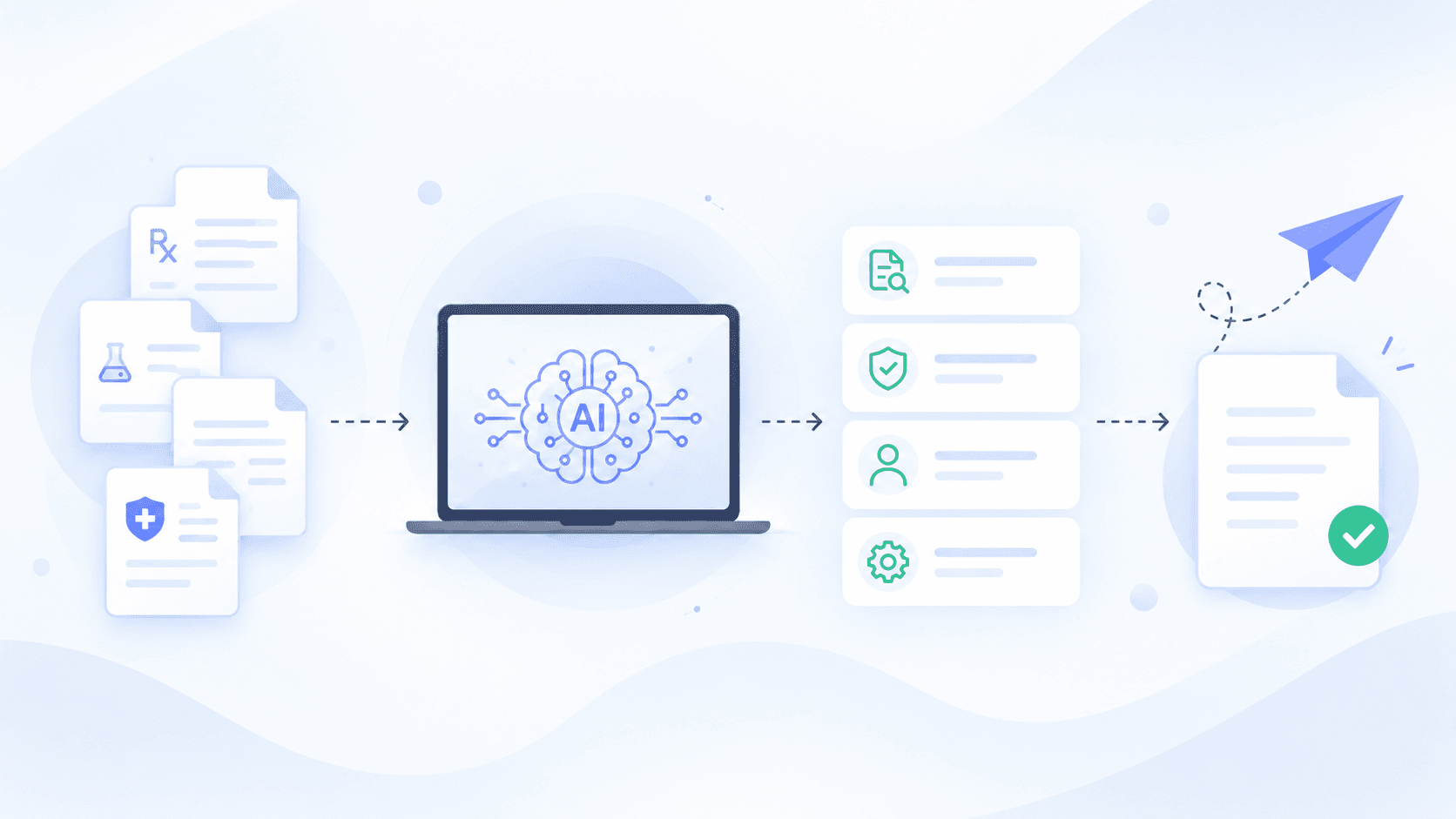
The AI Powered Patient Document Intelligence Platform was developed to automate healthcare insurance workflows by transforming unstructured patient documents into structured, submission ready TPA forms. The platform combines AI based document extraction, contextual validation, workflow automation, and automated PDF generation to reduce manual processing effort and improve submission accuracy. By streamlining the entire workflow from document ingestion to TPA dispatch, the solution enables healthcare and insurance teams to process patient records faster, minimize claim delays, and scale operations efficiently across high document volumes.

AI-Powered Patient Document Intelligence Platform for Automated TPA Submission

Overview

About the project

Industry
Insurance Tech

Carenav India operates within the healthcare and insurance facilitation ecosystem, helping hospitals, insurers, and TPAs manage patient documentation, pre authorization workflows, and claims processing operations. As patient volumes increased, the organization faced growing operational challenges related to manual document handling, fragmented workflows, and inconsistent insurance submission processes across multiple document formats. PySquad designed and implemented an AI powered document intelligence platform capable of processing scanned PDFs, handwritten records, prescriptions, discharge summaries, and insurance documents through a centralized automation pipeline.

01

The challenge

Operational Challenges in Healthcare Insurance Processing

1. Fragmented Patient Documentation
Patient records were received in multiple formats including scanned PDFs, handwritten forms, prescriptions, and discharge summaries. The lack of document standardization created fragmented workflows and made it difficult for operational teams to process insurance submissions consistently.

2. Manual TPA Form Processing
Operational staff manually entered patient and insurance details into TPA specific forms, resulting in time consuming workflows and frequent human errors. High dependency on manual processing reduced efficiency during peak submission periods.

3. Inconsistent Data Extraction Accuracy
Traditional OCR tools could extract raw text but failed to understand healthcare specific context and insurance terminology. This resulted in incomplete or inconsistent patient data that increased claim delays and rejection risks.

4. Lack of Contextual Validation
The existing workflow lacked an intelligence layer capable of validating extracted information across multiple patient documents. Missing or mismatched details often required repeated manual verification before submission.

5. Delayed Insurance Submission Workflows
Without automation across extraction, validation, and form generation processes, insurance submissions experienced processing delays that affected turnaround times and operational productivity.

6. Limited Scalability During Peak Volumes
The organization relied heavily on manual operators to process patient documentation. As submission volumes increased, operational teams struggled to maintain accuracy, consistency, and service quality at scale.

7. Compliance and Data Governance Risks
Healthcare and insurance workflows required secure handling of sensitive patient data, audit ready submission tracking, and controlled user access. Existing systems lacked centralized governance and operational visibility across the document lifecycle.

02

The solution

1. AI Powered Document Intelligence Platform
PySquad developed a centralized AI orchestration platform that automates healthcare document processing, insurance workflows, and TPA submission management within a scalable operational ecosystem.

Centralized document workflows

AI driven processing pipeline

Scalable healthcare infrastructure

2. Multi Format Document Ingestion
The platform supports ingestion of scanned PDFs, handwritten notes, prescriptions, discharge summaries, and medical reports through API based and batch upload workflows. Preprocessing services improve document quality before extraction.

Batch document ingestion

Image enhancement workflows

Automated document classification

3. Context Aware AI Data Extraction
Advanced OCR and layout aware transformer models were implemented to extract patient demographics, diagnosis information, treatment details, hospital records, and insurance related fields with high contextual accuracy.

Medical entity extraction

Healthcare specific AI models

Structured data generation

4. Intelligent Validation and Standardization
A contextual intelligence layer validates extracted information across multiple patient records to improve consistency and reduce submission errors. Confidence scoring mechanisms identify ambiguous extractions for additional review.

Cross document validation

Confidence based verification

Data normalization workflows

5. Automated TPA Form Generation
The platform dynamically populates TPA specific PDF forms using validated structured data. Automated mapping and validation workflows ensure submission readiness before export and dispatch.

Dynamic PDF population

Template based form mapping

Submission validation workflows

6. Human in the Loop Review System
An optional review layer was implemented for low confidence extractions and edge case scenarios. Operational teams can validate flagged records before final submission to maintain processing accuracy and compliance standards.

Manual review routing

Low confidence validation

Operational approval workflows

7. Workflow Orchestration and Automation
An event driven orchestration layer automates the entire workflow from document upload to TPA submission. Retry mechanisms, fallback logic, and process tracking improve operational reliability and processing efficiency.

Automated workflow routing

Retry and fallback mechanisms

Real time process tracking

8. Security and Compliance Infrastructure
Enterprise grade governance controls were implemented to protect patient data and support healthcare compliance requirements. The platform includes role based access control, audit trails, encrypted communication, and operational monitoring.

Role based access management

Secure healthcare data handling

Audit ready workflow tracking

Summary
The AI powered patient document intelligence platform transformed healthcare insurance processing into a scalable and automated operational ecosystem. By combining AI based extraction, contextual validation, automated TPA form generation, and workflow orchestration, the solution reduced manual processing effort, improved submission accuracy, and enabled faster insurance claim operations across high document volumes.

03

The result

Key Outcomes & Impact

1. Reduced Manual Processing Effort
The platform reduced manual data entry workloads by approximately 70 to 85 percent, allowing operational teams to focus on higher value insurance and patient support activities.

2. Faster Insurance Submission Turnaround
Automated extraction, validation, and form generation workflows improved document processing speed by 3 to 5 times compared to traditional manual operations.

3. Improved Data Extraction Accuracy
AI driven contextual extraction significantly improved the accuracy of patient, medical, and insurance related data, reducing downstream processing errors.

4. Lower Claim Rejection Rates
Improved data consistency and validation workflows reduced submission errors and contributed to a significant decrease in claim rejection and reprocessing cases.

5. Scalable Healthcare Document Processing
The cloud based architecture enabled the platform to process increasing patient document volumes efficiently without compromising operational performance or accuracy.

6. Enhanced Operational Visibility
Audit trails, workflow tracking, and centralized monitoring provided healthcare operations teams with better visibility into submission status and processing workflows.

7. Reduced Dependency on Manual Workflows
The organization successfully transitioned from fragmented manual processes to an AI driven automation pipeline capable of supporting long term operational scalability.

Stack

Technologies we used

  • Python
  • Django
  • AWS
  • PostgreSQL
  • React.Js
  • Next.Js

More stories

Related case studies

View all case studies

have an idea? lets talk

Share your details with us, and our team will get in touch within 24 hours to discuss your project and guide you through the next steps

happy clients50+
Projects Delivered20+
Client Satisfaction98%