Assisted operational workflows
Gather evidence across systems and propose a next step, while keeping write operations behind explicit permissions and approvals.
What you getScoped tools, review checkpoints and an action history.

LangGraph workflows development
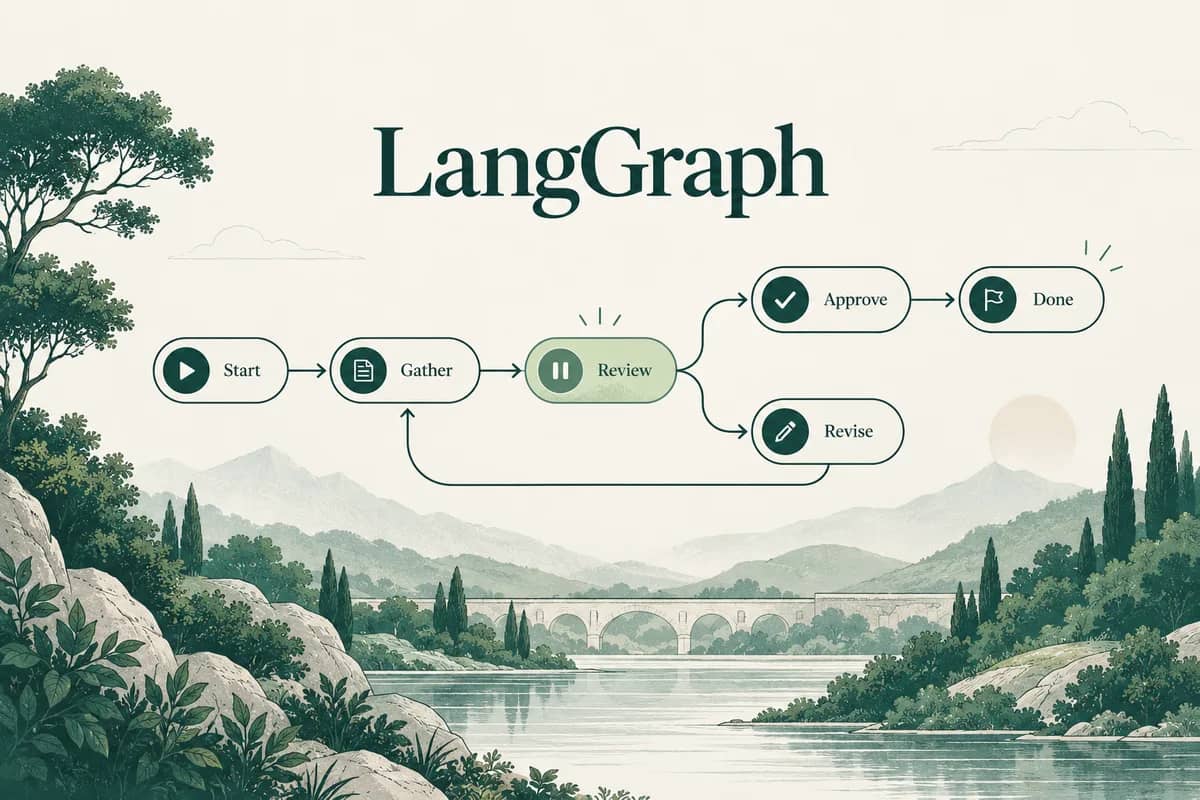
LangGraph engineering for tasks that span several decisions, tools or people. Make state explicit, put approval at meaningful boundaries, and retain a trace of how a result was reached.
Choose with context
Useful when a task needs branching, durable state, human intervention or recovery across several steps rather than a single model response.
A graph adds operational complexity. If a simple function or fixed pipeline solves the task, use that first. Checkpointing alone does not make external actions safe to repeat.
What we can build
Investigate a supplier discrepancy
Read order and invoice records
Prepare a correction
Wait before changing a record
Gather evidence across systems and propose a next step, while keeping write operations behind explicit permissions and approvals.
What you getScoped tools, review checkpoints and an action history.
Coordinate extraction, validation and exception review across multiple stages, with a defined owner for ambiguous cases.
What you getStructured state, resumable review and clear completion criteria.
Replace opaque loops with bounded execution, traceable steps and tests for the failures observed in real use.
What you getRun limits, checkpoint strategy and replayable evaluation cases.
An example architecture
Design tool calls to tolerate retries, protect external side effects, and track who approved an action. Stop conditions and recovery paths are part of the workflow.
Adapted to your systems, data and operating requirements during discovery.
From first scope to handover
We define the first useful release and its acceptance criteria together. Working software, deployment instructions and the decisions behind it stay with your team.
No. The surrounding application can integrate different model providers. Model choice and orchestration choice should be evaluated separately.
The design should distinguish a retryable step from an unsafe repeat. Checkpoint storage supports resuming state, while application-level idempotency and reconciliation protect external actions.
A new build, an existing codebase or one stubborn problem. Bring the context you have.
A little closer, wherever you are
Product engineering, AI and Odoo ERP, with a shared plan and a working rhythm built around your team.
Different time zones. One shared conversation.
Explore our global presence