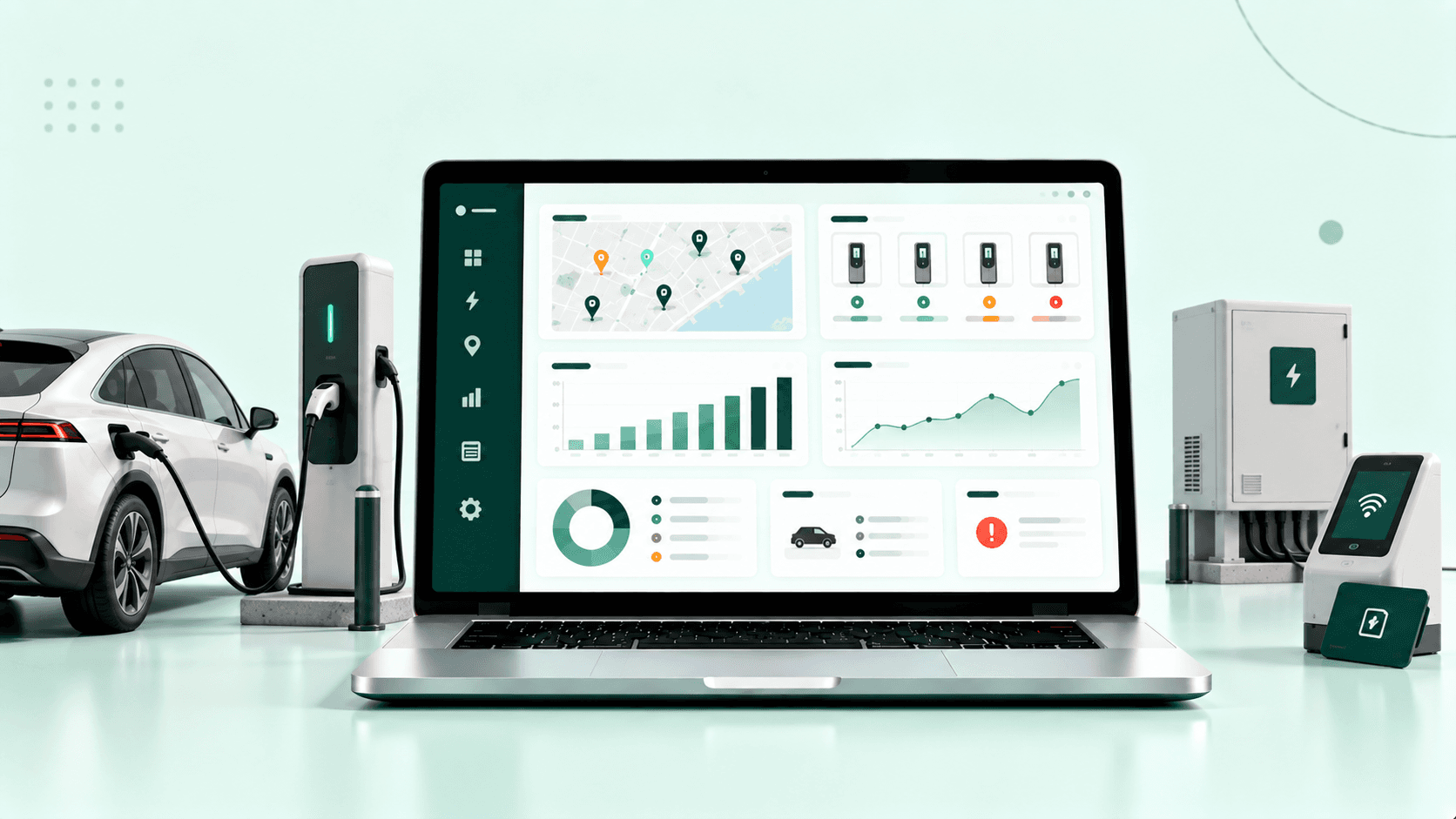
Build intelligent EV charging station management platforms for real-time monitoring, payments, load control, and user experience. PySquad delivers scalable EV infra solutions.
Reduced charger downtime and faster fault resolution
Improved billing accuracy and revenue visibility
Optimized energy distribution and peak load control
Scalable platform ready for network expansion
Results depend on scope, integrations and adoption.
The operating context
A clearer view of the whole operation.
EV charging operators need one system to manage chargers, sessions, billing, energy load, and driver experience. Disconnected tools create downtime, billing issues, and limited network visibility. A centralized platform connects charger operations, payments, monitoring, and analytics.
Where friction builds
Disconnected charger systems and manual processes reduce uptime and revenue.
Charging networks often use separate systems for charger monitoring, billing, and energy management. Operators struggle to detect faults quickly, reconcile sessions accurately, and manage different charger brands across multiple sites.
As the network grows, peak load control, payment accuracy, and operational visibility become harder to manage. Without one platform connecting devices, sessions, payments, and energy data, scaling increases operational risk.
Current approach
Manual session reconciliation
Separate tools for charger monitoring and billing
Basic dashboards without predictive insights
No structured load management across stations
Operational impact
Late fault detection increases downtime
Billing inconsistencies create revenue leakage
Peak demand causes energy overload
Limited insights restrict network scaling
Inside the solution
The capabilities behind the operation.
Review the functional scope, then discuss the requirements specific to your team.
OCPP-Compliant Charger Integration
Support for OCPP 1.6 and 2.0.1 with multi-brand charger compatibility.
Real-Time Monitoring & Remote Control
Remote start/stop, live diagnostics, firmware updates, and health monitoring.
Automated Billing & Session Management
Energy-based billing, QR payments, wallet integration, and session reconciliation.
Smart Load & Energy Management
Dynamic load balancing and predictive energy distribution across stations.
Mobile App & User Experience Layer
Geo-mapping, booking, availability tracking, and digital payments for EV drivers.
Analytics & Operations Dashboard
Utilisation metrics, revenue tracking, fault analysis, and performance reports.
Assess charger infrastructure and communication protocols
02
Design scalable OCPP-based backend architecture
03
Integrate billing, payments, and mobile applications
04
Implement monitoring, analytics, and predictive load controls
Our approach
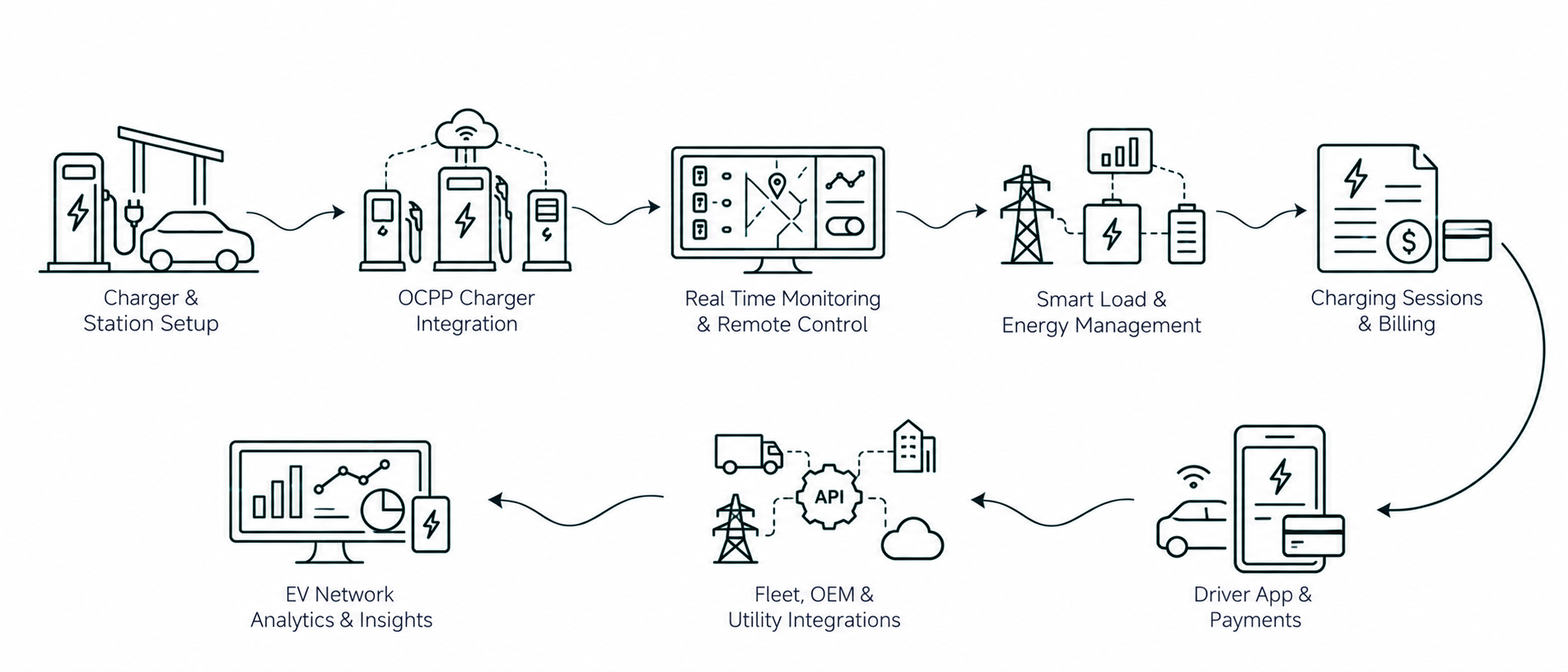
We design end-to-end EV charging management platforms that integrate chargers, IoT communication, payments, mobile apps, and analytics into a single operational ecosystem. Our systems support OCPP-compliant chargers, real-time monitoring, automated billing, predictive load balancing, and API integrations for fleet and OEM partners.
How it connects
The complete workflow, in one view.
Make an informed decision
Is this the right fit?
The right solution starts with the right operating requirements.
EV charging station management software is a backend platform used to monitor chargers, manage charging sessions, control user access, process payments, track energy consumption, and handle operational alerts. It helps charge point operators manage multiple chargers and locations from one system.
Can EV charging management software work with different charger brands?
Yes, if the chargers and backend support compatible OCPP versions. OCPP allows charging stations from different manufacturers to communicate with a central charging management system, reducing dependency on a single hardware vendor.
What is OCPP and why is it important for EV charging stations?
OCPP, or Open Charge Point Protocol, is the communication standard between EV chargers and charging management software. It enables functions such as session control, meter readings, charger status, remote commands, and device management across compatible charging hardware.
Can the system manage EV charging payments and billing?
Yes. EV charging platforms can support tariff configuration, charging-session billing, payment processing, invoices, wallets, and usage reporting. The exact payment methods and billing workflows depend on the payment gateway, region, and integrations used in the deployment.
How does load balancing work in EV charging stations?
Load balancing distributes available electrical capacity across multiple chargers so charging demand stays within a site's power limits. Dynamic load management can adjust charger power based on active sessions and available capacity, helping operators avoid overload and use existing electrical infrastructure more efficiently.
Start with your requirements
Let’s define your next step.
Tell us what needs to work better, the systems you use, and the scope you have in mind.