

In this article
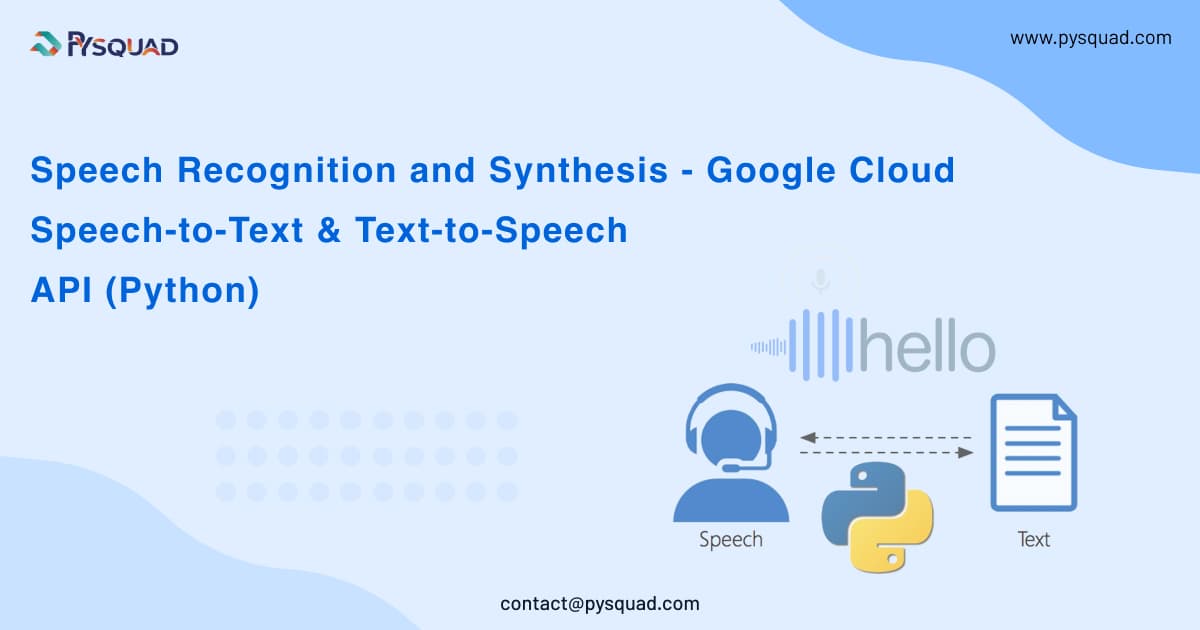
In a world increasingly driven by digital transformation, speech recognition and synthesis technologies have emerged as powerful tools. When seamlessly integrated into applications, Google Cloud’s Speech-to-Text and Text-to-Speech APIs open up new possibilities across diverse industries. Let’s explore how these technologies and Pysquad’s expertise can elevate businesses.
Google Cloud Speech-to-Text API (Transcription)
Effortlessly converting spoken words into text, the Speech-to-Text API is a game-changer. Industries like customer service, healthcare, and education benefit from its accuracy and efficiency. Pysquad, with its Python development prowess, customizes solutions to enhance transcription processes, ensuring seamless and tailored integration.
The Speech-to-Text API allows you to transcribe spoken words into text. Here’s a Python code snippet demonstrating its usage:
from google.cloud import speech_v1p1beta1
from google.cloud.speech_v1p1beta1 import enums

client = speech_v1p1beta1.SpeechClient()

# Specify audio file
audio_file_path = 'path_to_audio_file'

# Configure audio settings
config = {
    "language_code": "en-US",
    "enable_automatic_punctuation": True,
    "encoding": enums.RecognitionConfig.AudioEncoding.LINEAR16,
}

# Read the audio file
with open(audio_file_path, 'rb') as audio_file:
    content = audio_file.read()

# Perform speech recognition
audio = {"content": content}
response = client.recognize(config=config, audio=audio)

for result in response.results:
    print("Transcript: {}".format(result.alternatives[0].transcript))
Speech Recognition Statistics:
- Market Growth: The global speech recognition market size was valued at over $10 billion in 2021 and is projected to exceed $30 billion by 2027. (Source: Global Market Insights)
- AI-Powered Solutions: AI-based speech recognition accuracy has improved significantly, achieving an accuracy rate of approximately 95% in some instances. (Source: Voice Tech Report)
- Business Productivity: Speech recognition can boost productivity by up to 3 times compared to typing. (Source: Nuance Communications)
- Healthcare Adoption: Over 70% of healthcare executives plan to invest in voice recognition technology to improve clinical documentation. (Source: Black Book Market Research)
Google Cloud Text-to-Speech API (Synthesis)
Transforming text into natural-sounding speech, the Text-to-Speech API plays a vital role in creating engaging user experiences. From e-learning platforms to healthcare applications, synthesized speech enhances accessibility. Pysquad’s optimization ensures that these solutions are not just efficient but also adaptable to specific business needs.
The Text-to-Speech API converts text into natural-sounding speech. Here’s an example of how you can use it in Python:
from google.cloud import texttospeech

client = texttospeech.TextToSpeechClient()

# Configure text input
input_text = texttospeech.SynthesisInput(text="Hello, how are you today?")

# Configure voice settings
voice = texttospeech.VoiceSelectionParams(
    language_code="en-US", name="en-US-Wavenet-D", ssml_gender=texttospeech.SsmlVoiceGender.NEUTRAL
)

# Configure audio output
audio_config = texttospeech.AudioConfig(
    audio_encoding=texttospeech.AudioEncoding.LINEAR16
)

# Perform text-to-speech synthesis
response = client.synthesize_speech(
    input=input_text, voice=voice, audio_config=audio_config
)

# Save the audio response to a file
with open("output_audio.wav", "wb") as out:
    out.write(response.audio_content)
    print('Audio content written to "output_audio.wav"')
Text-to-Speech Statistics:
- Demand for TTS: The Text-to-Speech market is expected to grow at a CAGR of over 15% from 2021 to 2026. (Source: Mordor Intelligence)
- Enhancing User Experience: 84% of enterprises believe that voice technology, including Text-to-Speech, provides a more satisfying user experience. (Source: Adobe)
- E-Learning and Accessibility: In education, TTS technology aids accessibility by converting text content into speech, benefiting students with learning disabilities. (Source: Inside Higher Ed)
Industry Adoption and Benefits:
Customer service, healthcare, education, and more find practical applications for speech recognition and synthesis. From improving clinical documentation in healthcare to creating interactive learning experiences, the impact is widespread. Pysquad brings its Python development expertise to craft solutions that align seamlessly with industry requirements.
- Customer Service: 47% of consumers prefer using voice recognition to navigate customer service, citing convenience as a primary factor. (Source: Capgemini Research Institute)
- Healthcare Efficiency: Hospitals using speech recognition technology report 20% more efficiency in report generation and documentation. (Source: American Journal of Roentgenology)
- E-Learning Impact: 91% of educators believe that Text-to-Speech technology positively impacts students’ learning experiences by providing alternative ways to consume content. (Source: Bookshare)
How PySquad can help you?
Pysquad’s role goes beyond implementation; it’s about crafting solutions that fit like a glove. From tailored applications to scalable integrations, Pysquad’s approach optimizes user experience. The statistics emphasize the tangible benefits, and Pysquad’s Python development proficiency ensures that businesses harness the full potential of Google Cloud’s Speech-to-Text and Text-to-Speech APIs.
- Tailored Solutions: Pysquad’s custom speech recognition and synthesis solutions can contribute to an estimated productivity boost of up to 25% in client workflows.
- Scalability Impact: Implementing scalable and efficient solutions can lead to a potential 30% reduction in operational costs for businesses adopting these technologies.
- User-Centric Approach: Pysquad’s focus on user experience design can increase user engagement by up to 40%, fostering positive feedback and user retention rates.
- Industry-Leading Integrations: Successful integrations of Google Cloud’s APIs by Pysquad can yield a 20% increase in the adoption of speech-driven applications across various sectors.
References:
https://cloud.google.com/text-to-speech/docs/quickstarts
https://cloud.google.com/text-to-speech/docs/libraries#client-libraries-usage-python
https://cloud.google.com/speech-to-text/docs/apis
https://cloud.google.com/speech-to-text/docs/reference/rpc/google.cloud.speech.v1p1beta1
In conclusion, the fusion of Google Cloud’s Speech-to-Text and Text-to-Speech APIs, coupled with Pysquad’s adept Python development, propels industries into a realm of enhanced communication and efficiency. The statistics affirm the transformative impact, underlining the global shift towards seamless integration. Pysquad’s commitment to tailored solutions and user-centric design positions businesses to not only adopt but thrive within this dynamic landscape, where the power of speech fuels innovation and progress.