Odoo ERP for logistics companies with AI powered shipment tracking, fleet management, warehouse automation, route optimization, inventory control, and real time operational visibility by PySquad.
Improve real time visibility across logistics operations
Reduce transportation costs and shipment delays
Increase warehouse and fleet productivity
Scale logistics operations with AI driven automation
Results depend on scope, integrations and adoption.
The operating context
A clearer view of the whole operation.
Modern logistics companies need more than disconnected software and manual coordination to stay competitive. A customized Odoo ERP centralizes transportation, warehouse, inventory, fleet, procurement, and customer operations into one platform. PySquad enhances Odoo with AI driven automation, predictive analytics, and real time visibility to improve operational efficiency, reduce delays, and support scalable logistics growth.
Where friction builds
Disconnected Logistics Systems Create Operational Blind Spots
Many logistics companies rely on disconnected transportation, warehouse, fleet, and inventory systems that create data silos, manual processes, delayed reporting, and limited operational visibility. Teams struggle to coordinate shipments efficiently across multiple platforms.
Without AI enhanced Odoo ERP, businesses face inaccurate forecasting, inefficient route planning, warehouse bottlenecks, rising operational costs, delayed deliveries, and slow responses to disruptions that directly affect customer satisfaction and profitability.
Current approach
Using separate warehouse and transportation software
Tracking shipments with spreadsheets
Managing fleet operations manually
Using disconnected reporting systems
Operational impact
Limited real-time operational visibility
Manual processes increase operating costs
Poor inventory and fleet coordination
Slow response to delivery disruptions
Inside the solution
The capabilities behind the operation.
Review the functional scope, then discuss the requirements specific to your team.
Real Time Shipment Visibility
Track shipments, deliveries, and logistics performance from centralized Odoo dashboards with live operational insights.
Fleet & Transportation Management
Manage vehicles, drivers, maintenance schedules, utilization, and transportation performance from a single platform.
Warehouse & Inventory Control
Synchronize warehouse operations, inventory, barcode scanning, and order fulfillment with complete accuracy.
AI Powered Route Optimization
Improve delivery planning, reduce fuel costs, and optimize transportation using predictive AI models.
Workflow Automation
Automate dispatch, approvals, notifications, reporting, and repetitive logistics processes across departments.
Predictive Analytics & Reporting
Monitor KPIs, forecast demand, identify operational risks, and make faster business decisions using AI.
Evaluate current logistics operations and business goals
02
Design a customized Odoo ERP architecture
03
Configure logistics modules and business workflows
04
Integrate AI automation and third party systems
05
Deploy and validate the complete solution
06
Provide continuous optimization and long term support
Our approach
PySquad designs customized Odoo ERP solutions around your logistics workflows instead of forcing your business to adapt to generic software. We integrate transportation, warehouse, inventory, fleet, accounting, and customer operations into one connected platform. AI powered automation, predictive analytics, and intelligent reporting improve visibility, efficiency, and decision making. Every implementation is built to scale with your logistics business.
How it connects
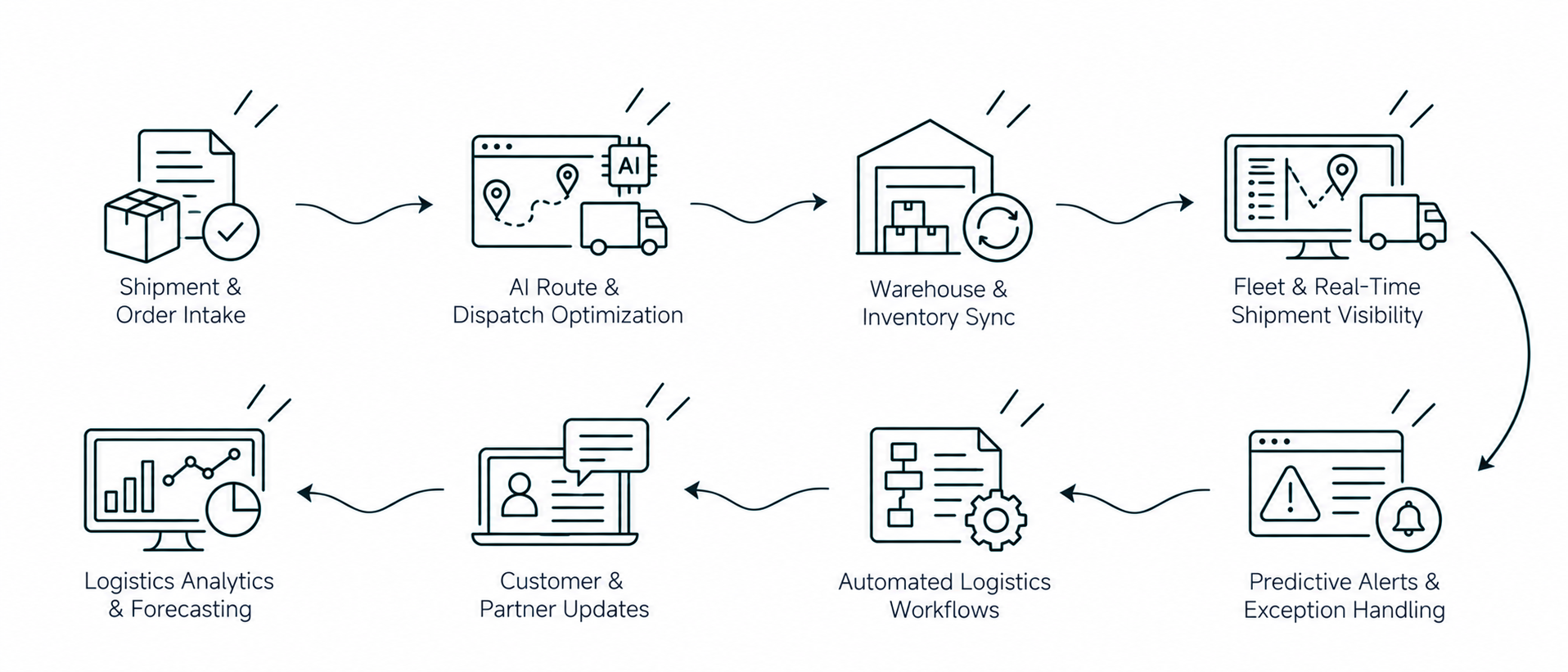
The complete workflow, in one view.
Make an informed decision
Is this the right fit?
The right solution starts with the right operating requirements.
AI strengthens Odoo ERP by automating routine logistics tasks, improving shipment forecasting, optimizing delivery routes, and providing real time operational insights. This helps businesses reduce delays, lower transportation costs, improve customer satisfaction, and make faster, data driven decisions.
What is Odoo ERP for logistics?
Odoo ERP for logistics is a centralized platform that manages transportation, warehouse operations, inventory, fleet management, procurement, accounting, and customer communication. It replaces disconnected software with one integrated system that improves operational control and business efficiency.
Can Odoo integrate with existing logistics software?
Yes. Odoo integrates with GPS providers, courier services, warehouse systems, barcode solutions, ecommerce platforms, accounting software, and other third party applications. PySquad customizes these integrations to create a seamless and reliable logistics ecosystem.
Is this solution suitable for growing logistics companies?
Yes. The solution is designed for businesses ranging from growing logistics providers to enterprise operations. Odoo's modular architecture allows companies to expand warehouses, fleets, users, and business processes without replacing their existing ERP platform.
Does Odoo support real time shipment tracking?
Yes. Customized Odoo ERP provides centralized shipment tracking, fleet monitoring, warehouse visibility, delivery updates, and customer notifications. AI further enhances visibility by predicting delays, identifying operational bottlenecks, and supporting proactive logistics management.
Start with your requirements
Let’s define your next step.
Tell us what needs to work better, the systems you use, and the scope you have in mind.