Results depend on scope, integrations and adoption.
The operating context
A clearer view of the whole operation.
As digital content scales across platforms, the risk of copyright violations and duplicate content increases rapidly. Creators, publishers, platforms, and enterprises need reliable systems to detect similarity, prevent infringement, and protect original work across text, audio, images, and video.
Manual reviews and rule-based plagiarism tools cannot keep up with content volume or subtle modifications. AI-driven similarity detection provides a scalable, accurate way to manage copyright risk proactively.
Where friction builds
Copyright risk grows when similarity is subtle, multimodal, and invisible at scale.
Businesses struggle to detect content that has been lightly modified, paraphrased, remixed, or reused across different formats. Manual review processes do not scale, while traditional plagiarism tools produce false positives and lack clear evidence trails.
Without accurate similarity scoring and defensible reports, teams face legal exposure, platform trust issues, and costly takedown disputes. The challenge is not finding exact copies, but identifying meaningful similarity across large, diverse content libraries.
Current approach
Rule-based plagiarism tools
Manual content reviews
Exact match or keyword-only detection
Separate tools for different content formats
Operational impact
Missed detection of modified or remixed content
High false positive rates
Poor scalability across large libraries
Lack of defensible evidence for disputes
Inside the solution
The capabilities behind the operation.
Review the functional scope, then discuss the requirements specific to your team.
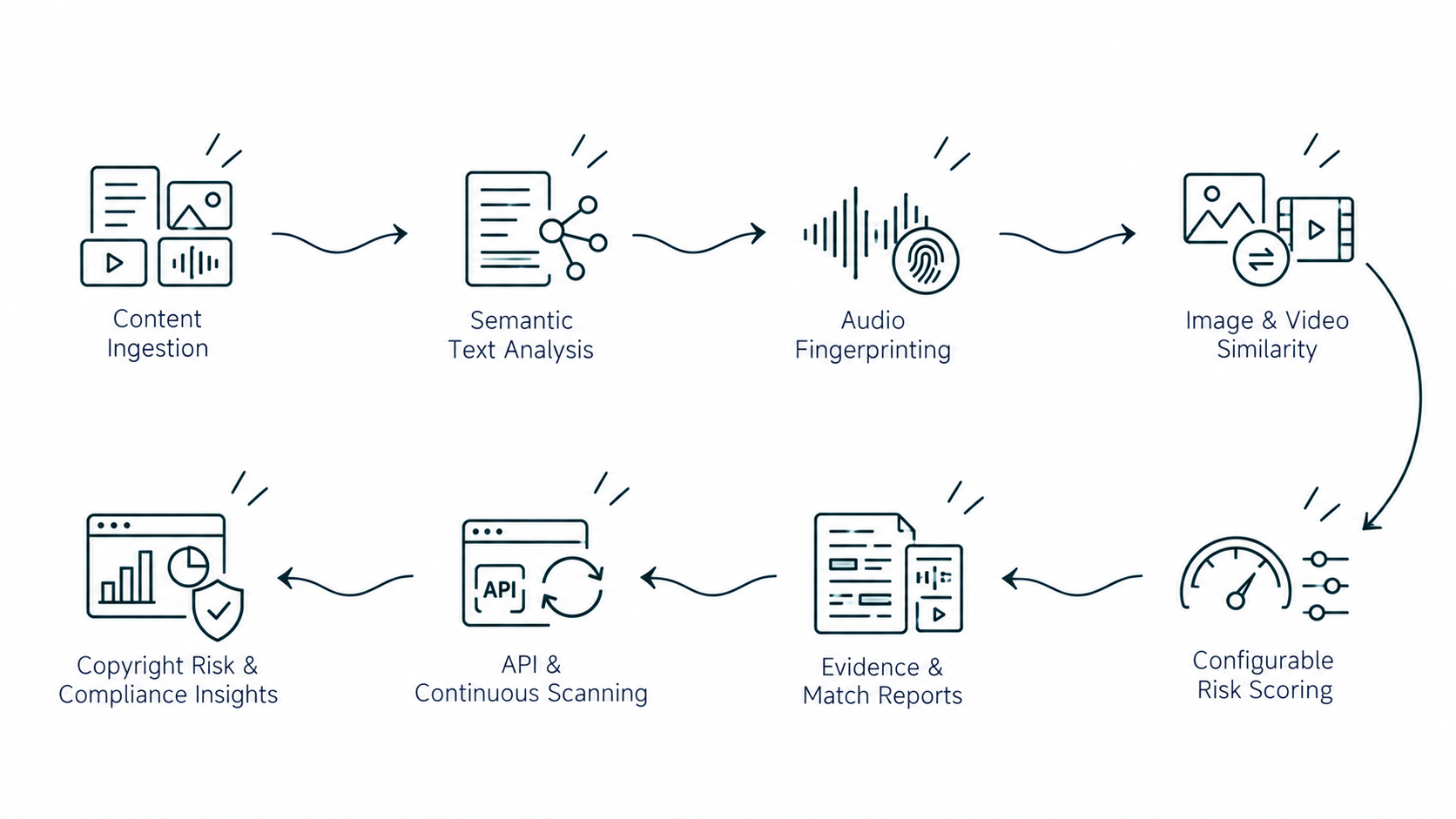
Semantic Text Similarity
Detect paraphrased and meaning-level similarity using embeddings.
Audio Fingerprinting
Identify reused or altered audio and music segments.
Image and Video Similarity
Perceptual hashing and visual analysis for images and videos.
Configurable Risk Scoring
Adjust similarity thresholds based on risk tolerance.
Evidence-Based Reports
Clear highlights of matched sections and sources.
API and Continuous Scanning
Integrate with CMS, UGC platforms, and moderation workflows.
We build AI-powered similarity systems that focus on semantic meaning, perceptual signals, and multimodal analysis. Our approach combines embeddings, fingerprinting, and vision models to detect real overlap, not superficial matches. Every detection is backed by evidence and designed for operational use at scale.
How it connects
The complete workflow, in one view.
Make an informed decision
Is this the right fit?
The right solution starts with the right operating requirements.