Better visibility into shipment readiness and outstanding clearance actions
Less repetitive work across document collection and coordination
Earlier identification of missing information and data discrepancies
More consistent clearance workflows across teams and shipments
Results depend on scope, integrations and adoption.
The operating context
A clearer view of the whole operation.
International shipments depend on accurate documentation, timely approvals, and coordination between importers, exporters, customs brokers, and logistics providers. PySquad builds customized clearance management software to organize shipment files, manage outstanding actions, identify document discrepancies, and improve visibility into clearance progress across trade operations.
Where friction builds
Why Customs Clearance Gets Delayed Across International Shipments
Commercial invoices, packing lists, transport documents, certificates, and permits often arrive at different times or contain conflicting shipment details. Missing information, declaration errors, pending approvals, and inspection requirements can create additional work when teams discover them close to shipment arrival or release.
When clearance teams rely on spreadsheets, email threads, and disconnected systems, it becomes difficult to identify which files are ready, who must act next, and which shipments need attention. These gaps can contribute to avoidable rework, delayed coordination, and additional storage, demurrage, or detention costs.
Current approach
Track clearance files through spreadsheets and email
Collect missing documents through repeated manual follow ups
Review shipment data across disconnected systems
Update customers using manually collected status information
Operational impact
Missing or conflicting shipment information is discovered late
Unclear task ownership slows document collection and approvals
Repeated data entry increases rework and operational inconsistencies
Fragmented status updates make urgent clearance exceptions harder to identify
Inside the solution
The capabilities behind the operation.
Review the functional scope, then discuss the requirements specific to your team.
Centralized Clearance File Management
Organize shipment records, commercial invoices, packing lists, bills of lading, certificates, permits, and supporting correspondence in a structured workspace.
Document Validation and Data Extraction
Support document completeness checks, compare key shipment details, flag discrepancies, and introduce OCR assisted data extraction with review steps where required.
Clearance Workflow and Task Management
Assign responsibility, manage pending actions, configure approval steps, and escalate outstanding requirements according to shipment priorities and business rules.
Declaration Preparation and Review
Organize declaration related data, review commodity descriptions and shipment details, and route incomplete or inconsistent information for authorized broker review.
Shipment Readiness and Release Tracking
Monitor document readiness, declaration progress, pending approvals, inspection updates, and release status received from supported integrations or recorded by authorized users.
Stakeholder and System Integration
Coordinate information requests and shipment updates between clients, brokers, suppliers, and logistics partners while connecting relevant ERP and freight systems.
Map existing clearance workflows, shipment types, and stakeholder responsibilities
02
Identify document requirements, data discrepancies, and recurring operational bottlenecks
03
Define workflow rules, task ownership, approvals, and exception handling
04
Plan integrations with relevant ERP, freight, and logistics systems
05
Implement and validate prioritized document and clearance workflows
06
Review operational feedback and refine processes based on agreed requirements
Our approach
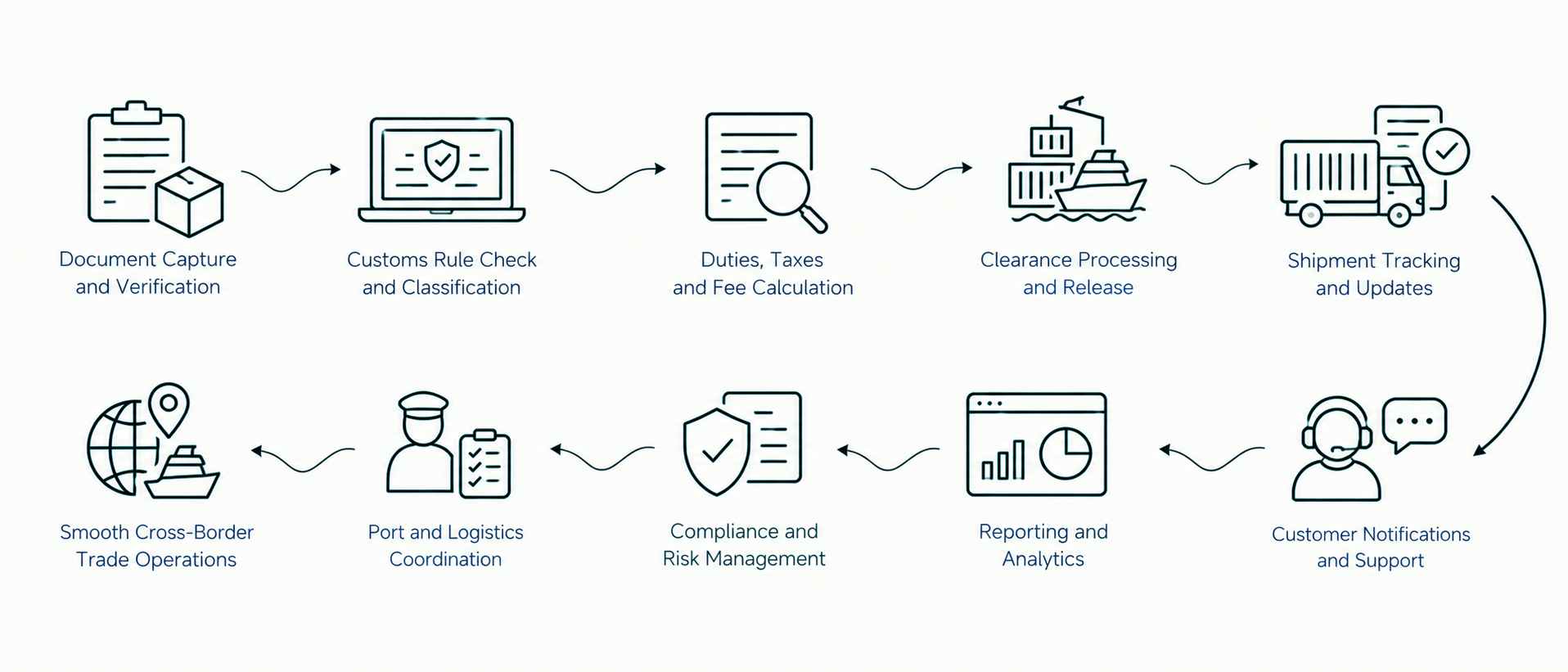
PySquad develops customs clearance management software around your shipment workflows, customer requirements, and existing business systems. We identify how documents are collected, shipment information is validated, clearance tasks are assigned, and release updates are communicated.
How it connects
The complete workflow, in one view.
Make an informed decision
Is this the right fit?
The right solution starts with the right operating requirements.
Customs clearance management software helps businesses organize shipment documents, coordinate clearance tasks, track outstanding requirements, and monitor progress toward customs release. Depending on the implementation, it can support customs brokers, freight forwarders, importers, exporters, and trade operations teams by connecting information and workflows that would otherwise be managed through spreadsheets, emails, and separate systems.
Can customs clearance software identify missing or incorrect shipment documents?
A customized solution can support document completeness checks, compare key details across available records, and flag discrepancies for review. OCR assisted extraction can also help capture information from supported documents. The validation rules depend on the document types, shipment requirements, and jurisdictions involved. Extracted or flagged information should be reviewed by authorized personnel before it is used in customs declarations.
Can the software automate customs declarations and filing?
The solution can organize declaration data, support preparation and review workflows, and integrate with supported customs filing systems where the necessary connections are available. Direct electronic filing depends on the destination country's systems, API access, authorization requirements, and project scope. The software should not be assumed to submit declarations to every customs authority automatically.
Can a clearance management platform support multiple countries?
A customized platform can organize clearance workflows across countries while accounting for differences in documentation, approvals, and operational requirements. Country specific rules and filing connections need to be assessed for each jurisdiction. Global workflow management does not automatically provide complete regulatory coverage or direct integration with every national customs system.
Can customs clearance software integrate with ERP and freight forwarding systems?
Yes, relevant integrations can be developed based on the available APIs, data formats, and requirements of your existing systems. Integration may help synchronize shipment records, document references, task updates, and clearance milestones. The exact systems, data flows, and synchronization behavior should be defined during technical assessment.
Start with your requirements
Let’s define your next step.
Tell us what needs to work better, the systems you use, and the scope you have in mind.