Results depend on scope, integrations and adoption.
The operating context
A clearer view of the whole operation.
Enterprise logistics has evolved beyond managing transportation and warehouse operations independently. Modern organizations require a unified platform that connects inventory, procurement, fulfillment, ERP, finance, and supply chain workflows into a single operational ecosystem. PySquad develops enterprise logistics software that integrates existing business systems, improves operational visibility, automates critical processes, and supports scalable logistics operations across multiple regions, warehouses, suppliers, and distribution networks.
Where friction builds
Enterprise Logistics Breaks Down When Business Systems Stay Disconnected
Enterprise logistics teams often manage transportation, warehouse operations, inventory, procurement, ERP, and financial processes across multiple disconnected applications. This creates inconsistent data, limited operational visibility, manual reporting, and slower decision making throughout the supply chain.
As organizations expand across warehouses, suppliers, carriers, and global markets, fragmented systems increase logistics costs, reduce operational agility, and make it difficult to maintain accurate inventory, coordinate fulfillment, and respond quickly to changing customer demand.
Current approach
Running separate TMS, WMS, and ERP systems
Reconciling logistics and financial data manually
Maintaining disconnected reporting platforms
Operating regional systems without centralized visibility
Operational impact
Reporting becomes inconsistent across systems
Manual reconciliation increases operational costs
End-to-end logistics visibility remains limited
Regional operations become harder to scale
Inside the solution
The capabilities behind the operation.
Review the functional scope, then discuss the requirements specific to your team.
Enterprise Logistics Operations Management
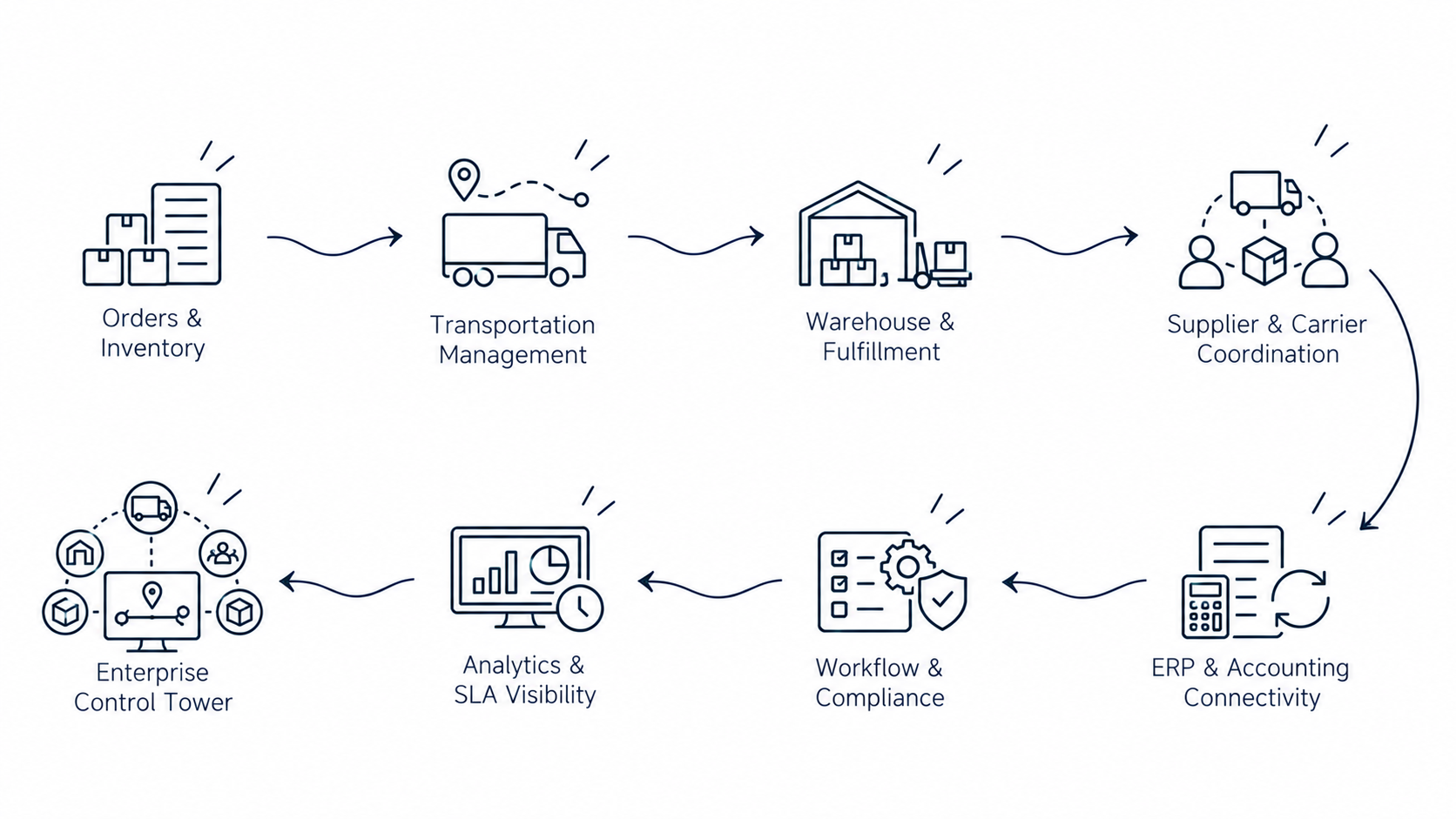
Centralize transportation, warehousing, inventory, and supply chain activities within a single enterprise logistics software platform.
Transportation Management System (TMS)
Plan, execute, and monitor shipments through integrated transportation management capabilities with real-time visibility.
Logistics and Warehouse Management
Coordinate warehouse operations, inventory movement, fulfillment processes, and distribution activities across multiple facilities.
Supply Chain Management Integration
Connect suppliers, carriers, warehouses, and customers through unified supply chain management workflows and shared operational data.
Accounting and ERP Connectivity
Integrate financial processes, invoicing, accounting systems, and ERP platforms to improve operational and financial alignment.
Enterprise Analytics and Visibility
Monitor logistics performance, transportation costs, inventory levels, SLA compliance, and operational KPIs through executive dashboards.
Product walkthrough
See the solution in action.
Take a closer look before starting a conversation.
Enterprise logistics software is a platform that manages transportation, warehousing, inventory, supply chain operations, analytics, and partner coordination within a unified system designed for large organizations.
How is enterprise logistics software different from a TMS system?
A TMS system focuses primarily on transportation planning and shipment execution, while enterprise logistics software combines transportation management, warehouse management, inventory control, supply chain workflows, analytics, and financial integrations within a broader operational platform.
Does enterprise logistics software integrate with supply chain management software?
Yes. Enterprise logistics software commonly integrates with supply chain management software, ERP systems, warehouse management platforms, transportation systems, and accounting applications to create a unified operational environment.
Can enterprise logistics software integrate with accounting software?
Yes. Enterprise logistics software can integrate with accounting systems, ERP platforms, invoicing tools, and financial reporting solutions to improve operational visibility and reduce manual reconciliation processes.
What features should enterprise logistics software include?
Key features include transportation management, warehouse management, supply chain visibility, inventory control, ERP integration, accounting connectivity, analytics dashboards, workflow automation, and compliance management.
Can enterprise logistics software integrate with SAP, Oracle, Microsoft Dynamics, or other ERP systems?
Yes. Enterprise logistics software integrates with ERP platforms such as SAP, Oracle, Microsoft Dynamics, and NetSuite using APIs, EDI, or middleware. This connects logistics, inventory, orders, and financial data to improve visibility, reduce manual work, and streamline enterprise operations.
Start with your requirements
Let’s define your next step.
Tell us what needs to work better, the systems you use, and the scope you have in mind.