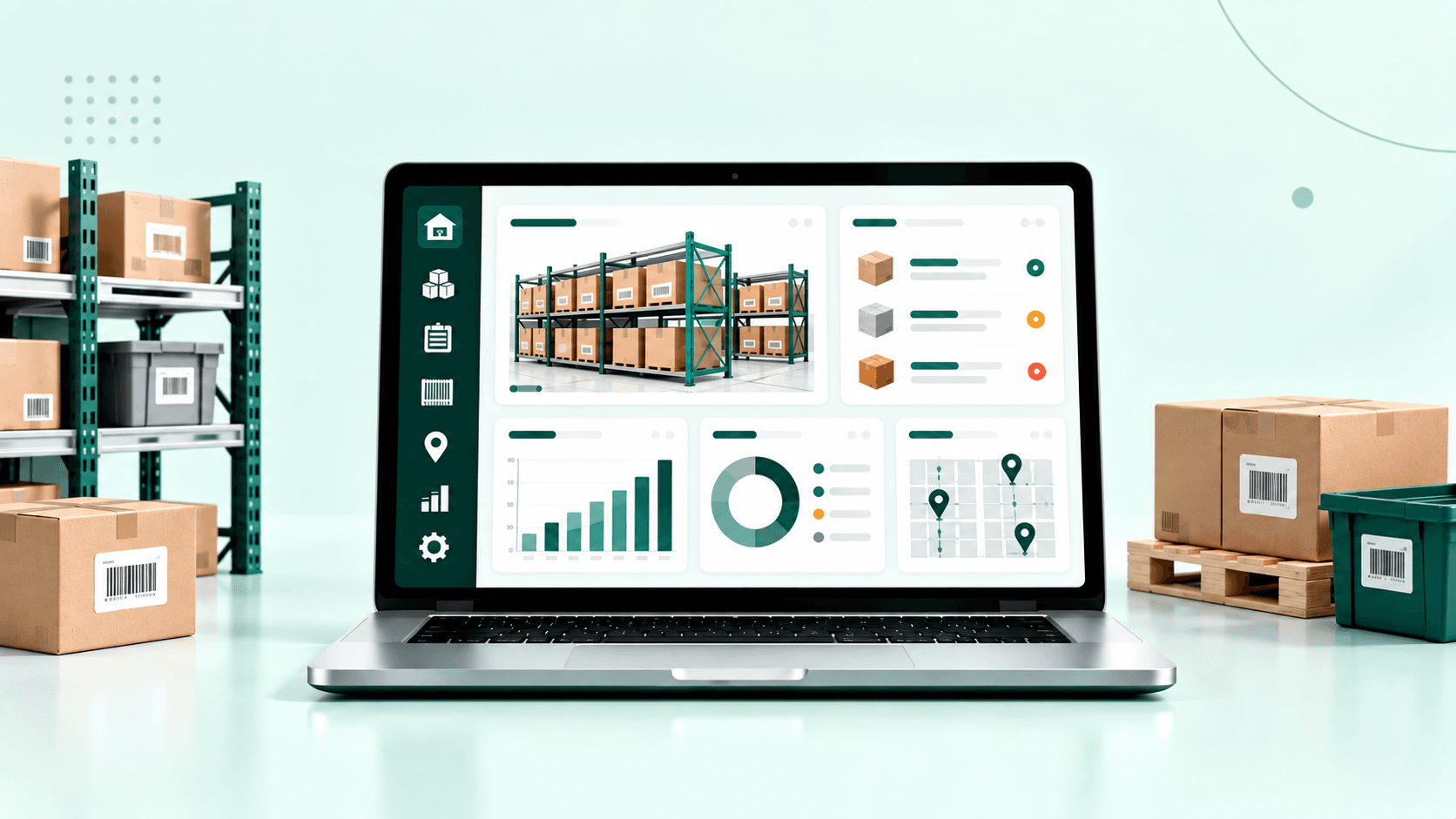
Streamline warehouse operations with an Odoo Warehouse Management System featuring barcode scanning, smart picking, replenishment, and real time inventory visibility.
Improve inventory accuracy across warehouse operations.
Reduce fulfillment time and warehouse processing costs.
Increase visibility into stock movement and warehouse performance.
Support scalable warehouse operations across multiple facilities.
Results depend on scope, integrations and adoption.
The operating context
A clearer view of the whole operation.
Warehouse performance depends on accurate stock, efficient picking, and clear visibility across every movement. Odoo connects barcode workflows, warehouse locations, replenishment, picking, and inventory reporting in one system.
Where friction builds
Warehouse delays often begin with inventory processes that cannot keep pace with business growth.
Warehouse teams lose time when inventory updates, picking, and replenishment rely on spreadsheets or disconnected systems. Without accurate location tracking, stock discrepancies become routine and fulfillment slows.
As order volumes increase, manual warehouse operations create higher labor costs, delayed shipments, and limited visibility, making it difficult to scale efficiently across one or multiple warehouse locations.
Current approach
Updating inventory manually after warehouse activities
Managing warehouse locations through spreadsheets
Using paper picking lists for fulfillment
Replenishing stock only after shortages
Operational impact
Inventory accuracy declines as volume grows
Warehouse staff waste time locating stock
Fulfillment becomes slower and error-prone
Management lacks real-time warehouse visibility
Inside the solution
The capabilities behind the operation.
Review the functional scope, then discuss the requirements specific to your team.
Barcode Driven Warehouse Operations
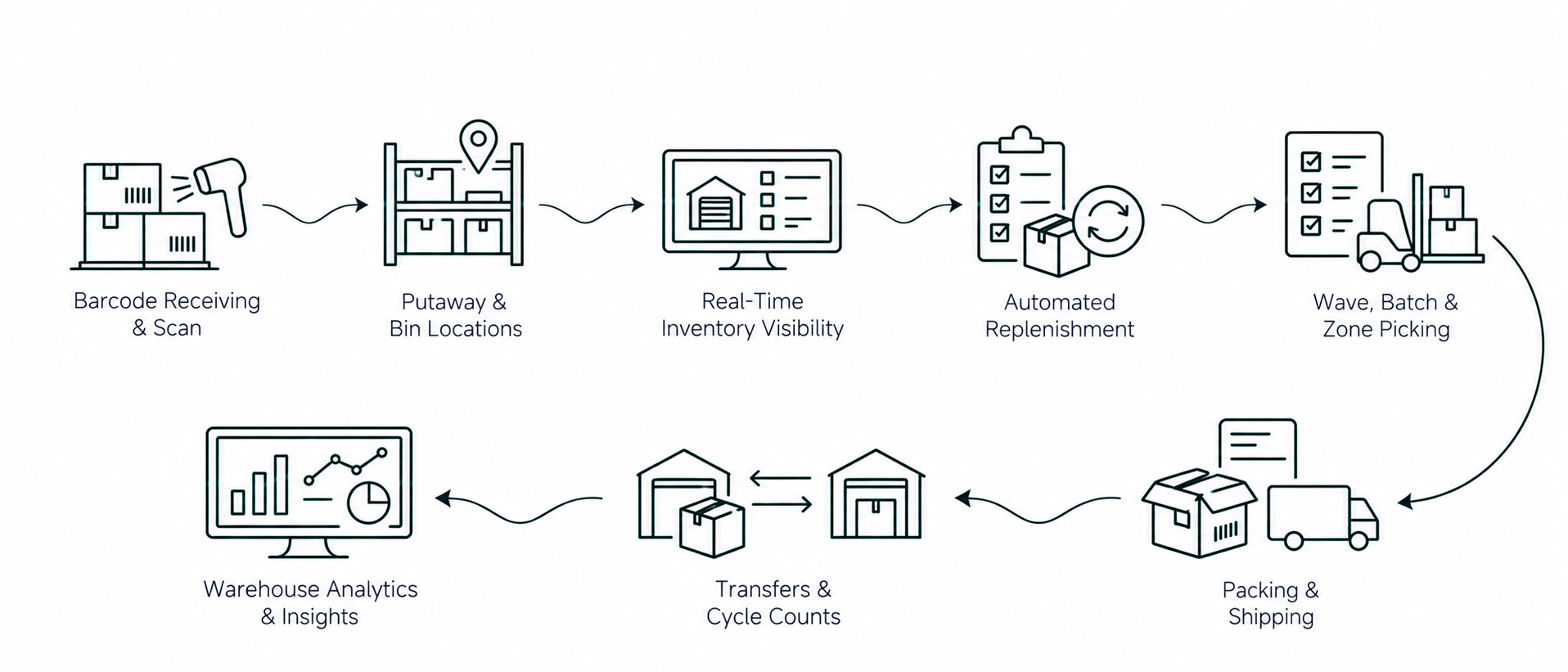
Support receiving, putaway, picking, packing, transfers, and shipping through barcode scanning for faster and more accurate warehouse execution.
Warehouse Location Management
Track inventory across warehouses, zones, aisles, racks, shelves, and bins with complete location level visibility.
Intelligent Picking Strategies
Configure wave, batch, cluster, and zone picking methods to reduce travel time and improve warehouse productivity.
Automated Replenishment Rules
Maintain inventory availability using configurable replenishment policies, minimum stock levels, and suggested stock movements.
Putaway and Removal Rules
Implement FIFO, FEFO, LIFO, or custom warehouse rules that match operational requirements and inventory characteristics.
Real Time Warehouse Analytics
Monitor inventory accuracy, warehouse productivity, stock movement, fulfillment performance, and operational bottlenecks through live dashboards.
Evaluate warehouse layout, inventory flow, and operational objectives.
02
Design warehouse locations, movement rules, and barcode workflows.
03
Configure Odoo Warehouse Management System for existing business processes.
04
Integrate inventory, purchasing, manufacturing, sales, and logistics operations.
05
Test warehouse scenarios using real operational data before deployment.
06
Provide user training, optimization, and ongoing implementation support.
Our approach
Every warehouse operates differently. We configure Odoo Warehouse Management System around your warehouse layout, barcode workflows, inventory movement, and fulfillment processes to improve accuracy, efficiency, and day to day operations.
How it connects
The complete workflow, in one view.
Make an informed decision
Is this the right fit?
The right solution starts with the right operating requirements.
An Odoo Warehouse Management System is a warehouse module within Odoo ERP that manages receiving, putaway, inventory storage, picking, packing, shipping, replenishment, and stock transfers. It combines barcode scanning, warehouse rules, and real time inventory tracking to improve warehouse efficiency while integrating with purchasing, sales, manufacturing, and accounting.
Does Odoo Warehouse Management System support barcode scanning?
Yes. Odoo supports barcode enabled warehouse operations using compatible scanners and mobile devices. Barcode workflows can be configured for receiving, inventory transfers, picking, packing, shipping, cycle counting, and stock adjustments, reducing manual data entry while improving inventory accuracy and operational speed.
Can Odoo Warehouse Management System manage multiple warehouses and locations?
Yes. Odoo supports multiple warehouses, storage locations, zones, racks, shelves, and bins from a single ERP platform. Organizations can define warehouse specific workflows, replenishment rules, transfers, and inventory visibility while maintaining centralized reporting across all facilities.
How long does it take to implement an Odoo Warehouse Management System?
Implementation timelines depend on warehouse complexity, inventory volume, barcode requirements, integrations, customization, and data migration. Smaller implementations may be completed within a few weeks, while enterprise warehouses with multiple locations and advanced workflows typically require a structured implementation plan, testing, training, and phased deployment.
Can Odoo Warehouse Management System integrate with manufacturing, purchasing, and shipping operations?
Yes. One of the primary advantages of Odoo Warehouse Management System is its native integration with purchasing, manufacturing, sales, inventory, accounting, and shipping modules. This allows inventory movements, procurement, production, and order fulfillment to remain synchronized without relying on disconnected warehouse applications.
Start with your requirements
Let’s define your next step.
Tell us what needs to work better, the systems you use, and the scope you have in mind.